History of the Flight
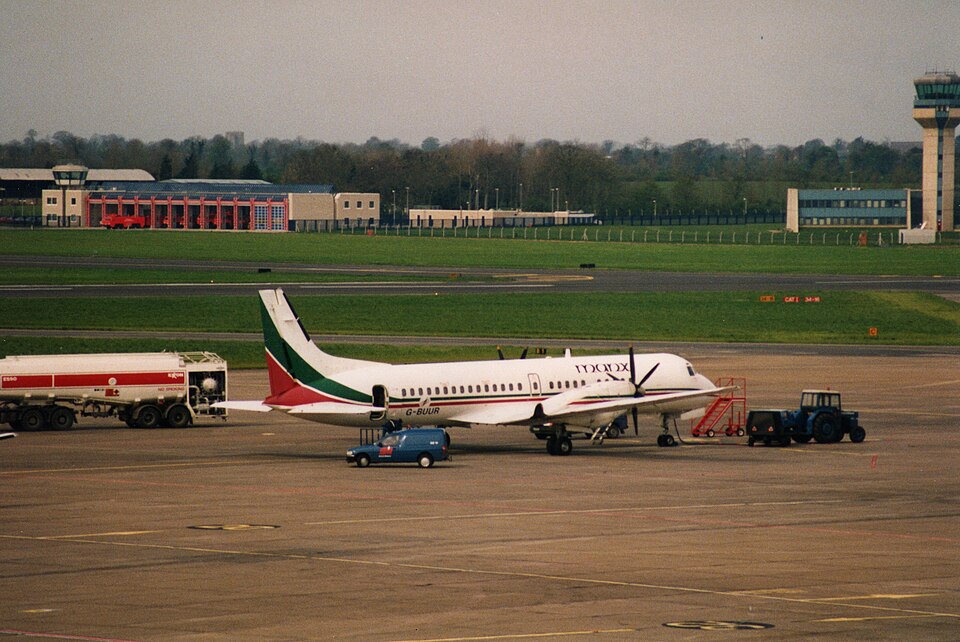
On 26 January 2016 at 1950 UTC, a BAe ATP (registration G-BUUR) departed Jersey for a night cargo flight to Guernsey. The co-pilot, who was pilot flying (PF), had completed the operator's BAe ATP training course the previous month and this was his first commercial aircraft type. The forecast indicated a strong southerly wind with possible severe turbulence and windshear. The PF believed he had experienced similar weather during training and was confident to handle the aircraft. Before departure, he briefed the commander, who was pilot not flying (PNF), about the expected approach to Runway 27 at Guernsey. He mentioned the routing for a missed approach but did not discuss the actions for a go-around.
After a normal take-off, autopilot system 2 (AP2) was engaged at approximately 1,000 ft aal and the aircraft levelled at 2,000 ft amsl. No significant turbulence was encountered. Runway 27 was in sight when the aircraft established on an ILS approach with AP2 still engaged. Visibility was good, surface temperature 11°C, and reported surface wind from 200° at 20 kt, with crosswind within the operator's advisory limits. At 1,000 ft agl, the PNF stated the aircraft was stable; gear extended, flaps at 20°. The estimated landing weight was 18,369 kg, giving a threshold speed (VAT) of 103 kt. The crew aimed for 118 kt (VAT+10 plus a 5 kt buffer) due to gusty conditions and forecast windshear.
The Approach
Approaching the decision altitude (200 ft aal), the PF attempted to disengage the autopilot by pressing the red disengage switch on his control wheel but did not hear the expected audio alert. Unaware, the PNF suggested disengaging the autopilot as he wanted the PF to have time to handle the aircraft in the wind. The PF pressed the switch again; still no alert. The decision altitude was announced, and the PF pressed the switch a third time and made small control column inputs, which felt extremely stiff.
Both pilots believed the autopilot was still engaged because no disengagement alert was heard. The PNF saw the PF “frantically pressing” the disengage switch and asked what was happening. The PF said “it won’t disconnect”, so the PNF pressed the disengage switch and the pitch trim switch on his control column, and also the ap switch on the autopilot controller, but still no alert. He could not recall checking the auto-flight mode annunciations. The PF thought he saw the ap annunciator on his PFD at some point.
The PNF asked if the PF had control; the PF was unsure. The PF later stated that the control column felt very stiff, “as if the autopilot was in”. The aircraft deviated above the glideslope, and the PF tried to pitch down and possibly reduced power. Shortly after, the PNF instructed a go-around because he was unsure if sufficient control was available to land in the crosswind, and he assessed the approach as unstable. This decision was made when the aircraft was close to the runway.
The Go-Around and System Activation
The PF advanced the power levers and pressed the go-around button on the right power lever with his left hand. This should have disengaged the autopilot and moved the flight director bars, but he noticed no change. He pressed the go-around button again, but still no response. However, he applied rearward force on the control column, and the aircraft pitched nose-up. The controls felt stiff but not unusually so. He called for go-around power, flap 15, and selection of hdg and psa modes. The PNF adjusted power levers to the go-around setting and moved the flap lever. Neither pilot could recall looking at the flight director bars or selecting the modes, and they were unsure if ias mode was used. Both saw a large decelerative speed trend on the PFD airspeed tapes during the go-around.
As power increased, the PF felt a strong pitch-up tendency and responded with unusually large forward force on his control column. The PNF also sensed excessive pitch-up, possibly 15–20°, and instinctively pushed forward on the left control column with his palms. He then heard a caution annunciation and saw a caution light on the Central Warning Panel (CWP). The PF saw the standby controls caution on the CWP. The pitch control forces then became lighter, similar to simulator experience with split elevator control.
The crew later stated that the go-around began to “normalise”. They retracted the flaps and levelled at 2,000 ft amsl per ATC instructions. They noticed an elevator split indicator on the overhead console. Both pilots then realised the autopilot was no longer engaged and successfully re-engaged AP2. The drill in the Quick Reference Handbook for ‘Standby Controls Warning (CWP)’ was actioned, during which AP1 was engaged briefly before re-engaging AP2. After the drill, AP2 was disengaged and re-engaged normally, with both pilots hearing the audio disengagement alert clearly.
They decided to divert to Jersey, where the runway is longer and the operator has a maintenance base. The commander assumed the role of PF for the approach to Jersey. During the approach, the autopilot was disengaged earlier than normal. At approximately 600 ft aal, the Enhanced Ground Proximity Warning System (EGPWS) annunciated a ‘terrain’ alert, but the crew disregarded it as they were visual with the runway and the approach was stable; the commander noted that terrain warnings are not uncommon at Jersey and Guernsey.
Post-Flight and Reporting
After landing, the crew observed the elevator engaged caption illuminated on the overhead panel. The commander informed engineering staff and made an entry in the Technical Log, stating that the autopilot failed to disconnect on approach and that the elevators split and standby controls engaged during the go-around. The following day (27 January 2016), the commander forwarded an incident report to the operator, and that evening the AAIB was notified. In the interim, the aircraft was electrically powered and the Cockpit Voice Recorder (CVR) recording of the incident flight was overwritten during maintenance activity.
Investigation Findings
Recorded flight data indicated the autopilot disengaged during the approach to Guernsey. Examination of the aircraft revealed no technical defects that would have caused the incident. As the CVR was unavailable, it was not possible to ascertain if an audio autopilot disengagement alert was generated. Some human factors were identified which may have contributed to the incident. The operator has made changes to its training policies and guidance concerning post-incident or accident response.