Summary
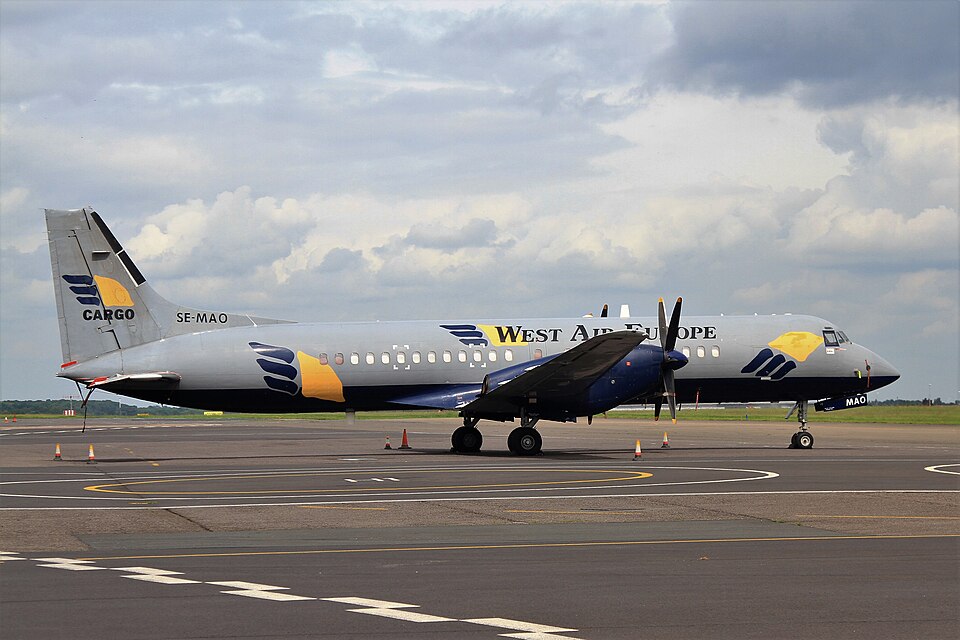
On 18 August 2020, a BAe ATP aircraft registered SE-MAO, operated as a commercial cargo flight, experienced roll control issues after departing from Jersey Airport. The flight crew managed to land safely at Guernsey Airport without damage or injuries. Despite extensive testing, no fault was found that could have caused the event. Two minor issues with autopilot computer maintenance and testing were identified and addressed by the operator.
History of the Flight
The aircraft departed Runway 26 at Jersey at 0817 UTC, with the co-pilot as pilot flying. After leveling at 2,000 ft and tracking toward the Guernsey VOR at approximately 200 KIAS, Air Traffic Control issued a right turn to heading 340°. During the turn, the crew felt a "jolt" accompanied by a left roll, which the autopilot corrected. A second "jolt" disconnected the autopilot, triggering a continuous "cavalry charge" audio warning. The co-pilot silenced the warning and took manual control, finding it difficult because the aircraft was "pushing to the left." She reported giving "everything I have to just hold it steady." The commander requested delaying vectors from ATC, receiving a heading of 070°. Slowing to 180 KIAS reduced abnormal control forces. The commander then tried the controls from his side, experiencing similar forces, and described the aircraft as "fully controllable but need[ing] a lot of right input." The co-pilot resumed flying while the commander managed the technical issue. All other flight deck indications were normal, and the flying control trims indicated neutral positions.
Crew Actions and Communication
The commander reported a "slight control problem, nothing major, nothing serious" to ATC and requested left turns for an ILS approach. He prepared for a manually-flown ILS using the flight director. After using aileron trim, the co-pilot noted improvement. The commander led an approach brief covering the implications of abnormal control forces during a possible go-around. Descending out of cloud at about 1,500 ft, the flight director modes failed and could not be reselected. The co-pilot continued using raw data, with the commander making standard callouts. The aircraft landed at 0831 UTC and taxied normally. After engine shutdown, the controls felt normal. The commander stated they had spare capacity but chose not to execute the Aileron control jam checklist because aileron control was achievable, and prioritized a prompt approach given workload and the potential for worsening conditions. The co-pilot considered the handling on final approach "ok," attributing it to the slower speed and straight descent rather than a resolved fault.
Meteorological Information
The weather report for Guernsey at 0820 UTC indicated wind from 200° at 9 kt, visibility 10 km or more, broken cloud at 900 ft, showers in the vicinity, temperature 18°C, and QNH 1010 hPa.
Recorded Data
The aircraft was equipped with a magnetic tape flight data recorder and a solid-state cockpit voice recorder, both of which provided good quality recordings. Radar data supplied geographic position. The FDR data showed that at approximately 2,000 ft and 200 KIAS in a right turn passing through heading 330°, the aircraft rolled sharply left by 5°, then shortly after by another 10°. Each roll was preceded by rapid movement of both ailerons in the direction consistent with the observed roll. No notable turbulence was indicated by normal acceleration values.
Aircraft and System Information
SE-MAO was a British Aerospace ATP manufactured in 1989, with 28,164 cycles and approximately 28,650 flight hours. Initially configured for passenger transport, it was modified for cargo operations in 2007. The last reported autopilot fault was in June 2019 and was successfully rectified. The autopilot system consists of two independent computers and servos with electromagnetic clutches. Out-of-trim indicators display servo load; if thresholds are exceeded, an amber trim light illuminates. Automatic disengagement occurs under various failure conditions, including roll angle exceeding 35° or a difference greater than 5° between the two attitude heading reference units.