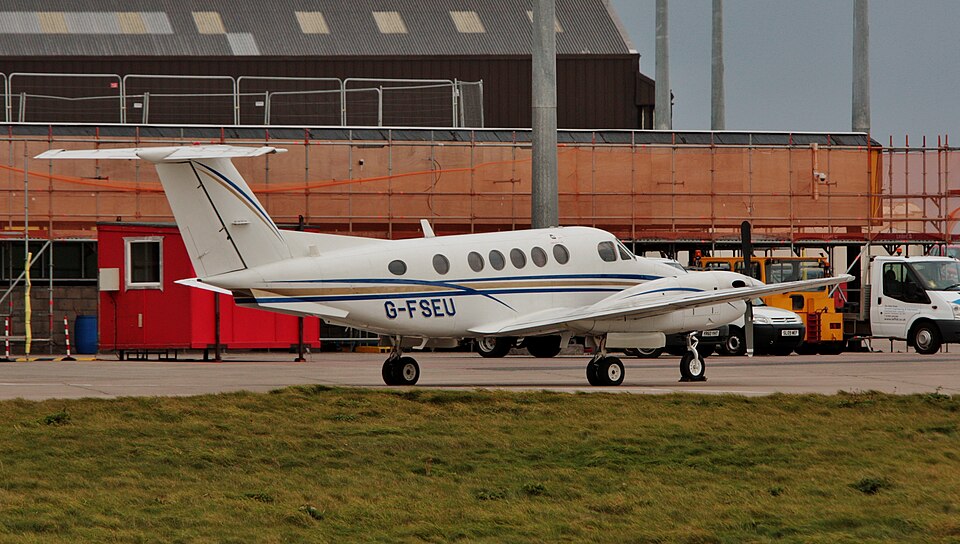
Incident
On 28 February 2020, a Beech 200 Super King Air (registration G-FSEU) was climbing through 8,800 ft after departing Doncaster-Sheffield Airport on a commercial flight to Wick. The pilots noticed an electrical burning smell in the cockpit, followed by grey smoke in the cabin. A MAYDAY was declared, and the aircraft returned to Doncaster. During the approach, when the flaps were selected to the approach position, they remained retracted. The pilots then found that the flap motor circuit breaker had tripped. The aircraft landed uneventfully, and airport rescue services used thermal imaging to detect a hotspot on the left fuselage below the cabin floor, where the flap motor is located. No fire was found.
Aircraft and Flight Details
The aircraft was a Beech 200 Super King Air, built in 1978 (serial BB-331), fitted with two Pratt & Whitney Canada PT6A-41 turboprop engines. The flight was a commercial air transport operation with two crew and no passengers. The commander, aged 35, held a Commercial Pilot's Licence and had 856 total flying hours, with 393 hours on type. Prior to departure, the commander had checked the flap system by cycling the flaps through their full range and visually comparing positions. A flapless takeoff was conducted from Runway 20.
Findings
Examination revealed heat damage and a burnt smell from the flap motor. The flap motor circuit breaker was found to be intermittent in operation. The flap motor, gearbox, and flap actuators had been replaced during Phase 3 maintenance on 17 January 2020, and had operated for 56 flap cycles since then. The maintenance organization determined that wear in the flap cam and link-arm assembly prevented the flaps-up limit switch from operating when the flaps were retracted. As a result, electrical power continued to be supplied to the motor even after the flaps reached the retracted position, causing the motor to overheat and emit fumes and smoke. Under normal circumstances, the circuit breaker would have tripped to protect the motor, but its intermittent fault prevented it from doing so initially.
Cause
The smoke was caused by overheating of the flap motor. The flaps-up limit switch had not operated due to wear in the system, so electrical power continued to be supplied to the motor after the flaps reached the retracted position prior to takeoff. The flap motor circuit breaker was intermittent and had not initially tripped to protect the motor from overload.