Incident Description
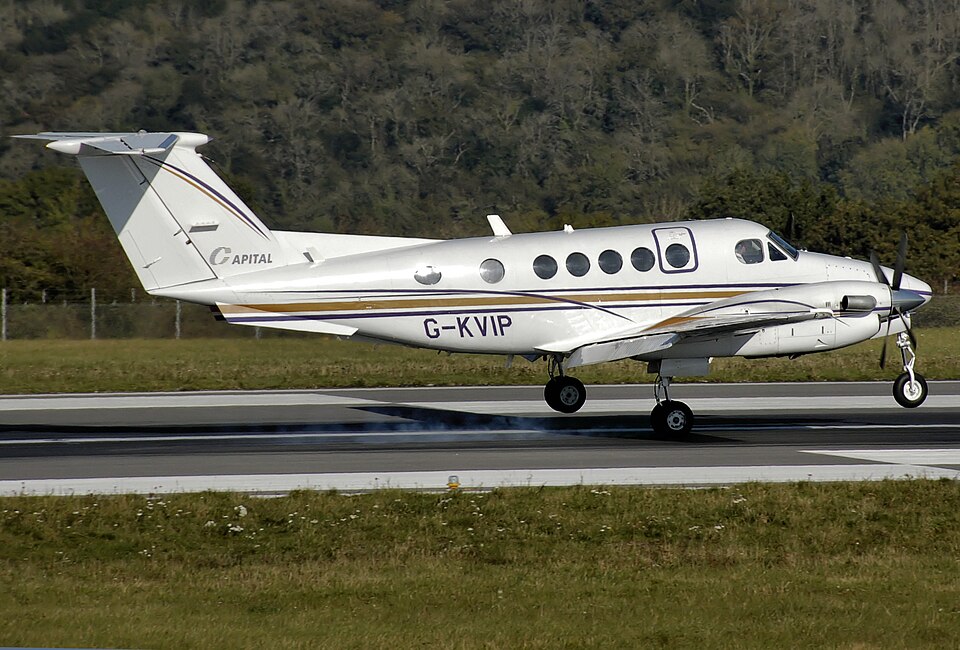
On 31 December 2014 at 1757 UTC, a Beech 200 Super Kingair, registration G-KVIP, was taxiing at Newquay Airport, Cornwall, after refueling. The pilot was instructed to make a 90° right turn to join the Alpha taxiway and then a right turn to proceed to the A2 holding point. As the aircraft commenced the right turn, the occupants heard a loud bang and felt a judder. The pilot stopped and asked the passenger, a medical technician, if he could identify the source. The passenger suggested it might be equipment moving in the baggage compartment. The pilot resumed taxiing. Upon reaching the holding point, ATC informed the pilot that he may have struck something. The aircraft returned to its parking slot and shut down.
Aircraft and Occupants
The aircraft was a 1979 Beech 200 Super Kingair (serial number BB-487) powered by two Pratt & Whitney Canada PT6A-41 turboprop engines. It was operated on a commercial air transport (passenger) flight, but no passengers were on board. The crew consisted of the pilot and a medical technician. The pilot held an Airline Transport Pilot's Licence, aged 39, with 4,421 total flying hours (142 on type). Neither crew member was injured.
Damage
The right propeller, the right side of the nose, and the right main landing gear door sustained damage. The propeller had struck a panel on a mobile airfield barrier system (MABS) equipment; the panel was found some distance away. The MABS almost certainly moved as a result of the collision, so its pre-impact position could not be established.
Contributing Factors
According to the investigation, it is likely that the position of a refueling bowser during refuelling, and the pilot's position in the aircraft, contributed to the pilot not seeing the MABS before the aircraft struck it. The bowser had been parked in front of the aircraft during refuelling, potentially obstructing the pilot's view during his external inspection. Additionally, the aircraft structure likely partially or completely obstructed his view of the MABS from the left pilot seat. The MABS was unlit.
Airfield Information
The parking stands on Alpha Apron (stands 20-24) required marshaller guidance for parking, but no such requirement existed for taxiing out. Nosewheel guidance lines were painted for taxiing onto the stand but not for exiting. The MABS was positioned between Stand 23 and Stand 22 to mark a restricted area. The weather was night with good conditions.