Synopsis
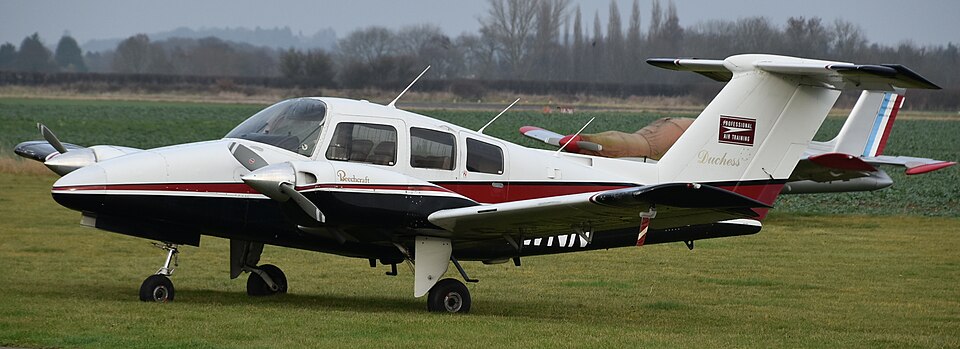
On 3 May 2017, a Beech 76 Duchess, registration G-TWNN, sustained damage to its propellers, engines, and fuselage after landing with the landing gear retracted at Wellsbourne Mountford Airfield, Warwickshire. The aircraft was being operated on a training flight with two crew members on board; there were no passengers, and no injuries were reported. The commander, who held an Airline Transport Pilot’s Licence and had 15,000 hours of total flying experience (with 20 hours on type), assessed the cause of the accident as “over-concentration on the flying and training aspects of the exercise, to the detriment of aircraft basic procedures.”
History of the Flight
The commander was conducting a training flight to prepare the handling pilot for a Multi-Engine Piston (MEP) class rating and a single-pilot instrument rating renewal. The handling pilot occupied the left seat, while the commander was seated in the right seat. After completing upper air exercises, the handling pilot flew two circuits to Runway 36 for normal two-engine touch-and-go landings in moderately turbulent conditions with a 10 kt crosswind component. The commander noted that the only training issue during these circuits was the handling pilot’s tendency to over-control power to achieve the required speeds on final approach.
The accident approach, also to Runway 36, was performed as a flapless approach for a touch-and-go landing. The commander reported that the handling pilot’s speed control was again problematic, and his own attention became focused on monitoring the airspeed. The aircraft was equipped with a single airspeed indicator (ASI) mounted on the left side of the left instrument panel. The commander stated that because the ASI indications were not clearly visible from the right seat, additional concentration was required to monitor the airspeed. During the approach, there were small airspeed control issues that required verbal input from the commander.
During the flare, which was slightly high, the commander was talking the trainee through the correct touchdown technique and did not notice that the landing gear was still selected UP. The aircraft landed in the normal landing attitude and skidded down the runway for approximately 150 m, drifting left of the centerline before coming to rest. The aircraft was made safe and vacated through the normal cockpit entry doors.
Commander's Assessment
The commander assessed the cause of the accident to be “over-concentration on the flying and training aspects of the exercise, to the detriment of aircraft basic procedures.”