History of the Flight
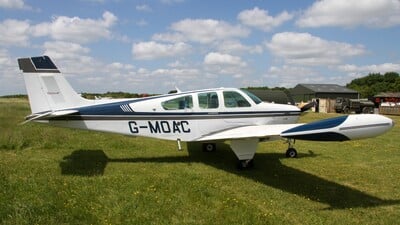
The aircraft, a Beech F33A registered G-MOAC, departed Guernsey at approximately 1630 hrs on 9 September 2022 for a short flight to its home airfield of Alderney. The pilot recalled descending to 1,000 ft on a QFE of 1002 hPa and joining downwind for Runway 26. Visibility was good with no low cloud, and the runway was clearly visible from the downwind leg. The pilot turned onto base leg, believing he was correctly positioned, then turned onto final approach at 500 ft QFE at 75 kt. There was some glare from the low evening sun, but the pilot continued the approach on the centreline. The glare significantly reduced the pilot's vision ahead, though he could see the approach lights. He did not recall seeing the APAPI lights. As he continued the approach, the glare persisted, and the aircraft descended below the glidepath, striking the approach lights.
Accident Details
The aircraft struck the last three approach lights before the threshold and then a threshold light before reaching the runway. It ran a short distance along Runway 26 before exiting to the right onto the grass and stopping on grass Runway 03/21. The aircraft's fuel tanks were ruptured, spilling fuel. Air Traffic Control at Alderney was not immediately aware of the collision but alerted the Rescue and Fire Fighting Service (RFFS) when the aircraft left Runway 26 and the pilot stopped responding to ATC calls. When the RFFS arrived, all three occupants had disembarked and were uninjured.
Aerodrome and Accident Site
Alderney Airport's Runway 26 is 880 m long with an APAPI glidepath indicator and a centreline approach lighting system extending 420 m from the threshold, mounted on pylons due to rising ground. The first of three light masts struck was 175 m from the threshold. Mast 1 was severed halfway up; Mast 2 was struck low down, with ground marks suggesting ground contact. The most serious damage to the right wing likely occurred at Mast 2, still 117 m from the threshold. Fuel spillage began at Mast 2.
Aircraft Information
The aircraft was 33 years old. Damage included the left wing leading edge, right wing root, and propeller blades. The aircraft was damaged beyond economic repair.
Analysis and Conclusion
The flight proceeded normally until final approach. The low sun aligned with the runway, and glare exacerbated by micro scratches on the windshield caused the pilot to lose sight of the runway. The pilot could see the approach lights but not the threshold lights, runway edge lights, or APAPIs, which would have provided vertical guidance. The pilot did not consider a go-around, believing the aircraft was correctly positioned. The aircraft descended below the glidepath and struck the lighting masts. The pilot lost visual references and descended below the glidepath due to sun glare on a scratched windshield.