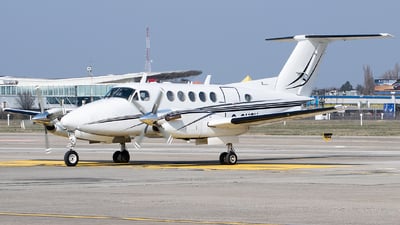
History of the Flight
The pilot was positioning the aircraft from Lydd to Alderney. During approach to Alderney, after selecting the landing gear down, the left main landing gear green light did not illuminate, indicating the gear was not down and locked. The pilot confirmed the bulb worked and recycled the gear, but the light remained off. A go-around was performed, and the pilot diverted to Exeter, where the aircraft was maintained, declaring a MAYDAY. A flypast of the tower was conducted, and observers confirmed the left main landing gear was lowered. The pilot made a normal approach and landing on Runway 26. He reported a soft touchdown, but as weight was taken by the landing gear, the left main gear collapsed. He held the left wing up as long as possible, but the wing and belly pod contacted the runway. The tips of the left propeller also struck the runway. After the aircraft came to rest, the pilot shut down the right engine and made the aircraft safe before exiting.
Aircraft Information
The Beechcraft 200, a member of the Super King Air family, is a pressurised twin turboprop utility aircraft with a retractable tricycle landing gear. G-GHSV was fitted with an electro-mechanical landing gear system. The main landing gear down-locks are provided by notched hook and plate attachments on the drag braces. A manual gear extension handle is available in the cockpit. The aircraft had been fitted with overhauled landing gear actuators in February 2020, 170 flying hours before the accident, at which time the down-lock rigging was set. No further maintenance of the actuation system was required until August 2022. At the time of the accident, the aircraft's certificate of airworthiness and airworthiness review certificate were valid.
Examination
The aircraft was recovered to a maintenance facility for examination. With the aircraft jacked, the left main landing gear lowered under gravity, revealing that the actuator shaft had failed close to the rod end clevis. The down-lock mechanism was damaged and missing the hook and lever attachment on the notched hook; these components were not recovered. Laboratory examination of the damaged actuator showed the actuator shaft had failed in buckling around its thinnest section and had bent where it exited the actuator body when fully extended. The actuator trunnions had fractured. Fractures on the down-lock notched hook were assessed to be in shear overload with no evidence of pre-existing cracks.
Analysis
The damage to the down-lock mechanism suggests that when the landing gear was lowered, the locking plate did not fully engage with the notched hook, leaving the gear unlocked. During landing, the unlocked drag brace began to fold, forcing the locking plate through the partially engaged hook, causing the hook to fracture. The drag brace continued to fold and loaded the actuator, causing it to buckle. This loaded the lever attachment of the notched hook, leading to its failure as the gear collapsed. It is likely that the down-lock rigging had lost adjustment, preventing full engagement of the left main gear down-lock. The cause of the loss of rigging adjustment could not be established. The rigging had been set at actuator installation 170 hours prior, making incorrect rigging at that time unlikely.