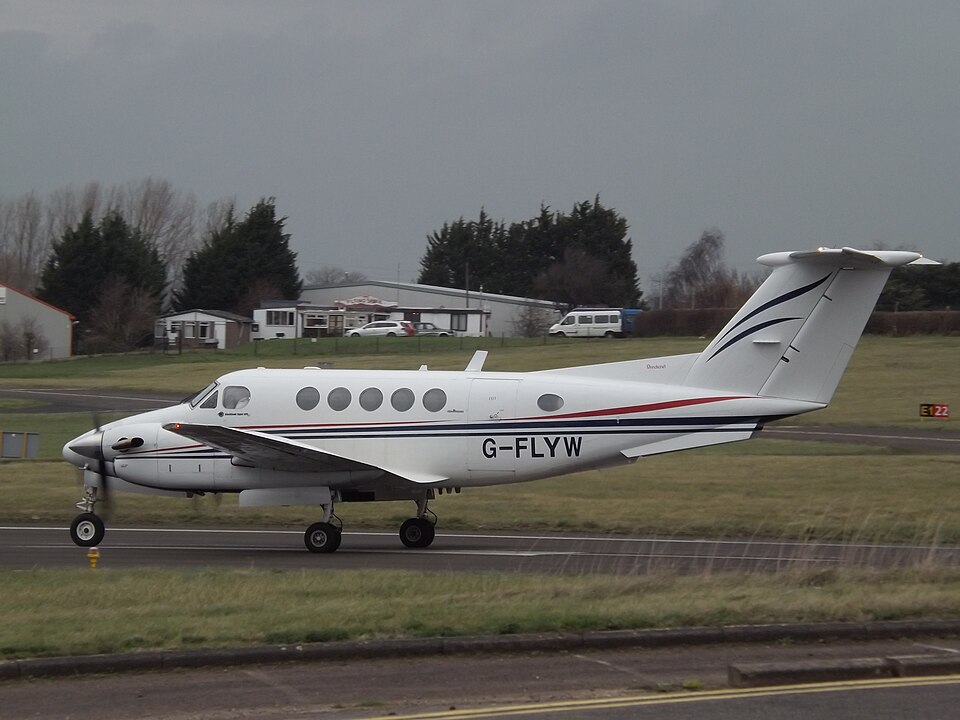
Accident
On 20 March 2020, at 1141 UTC, a Beechcraft Super King Air 200 (registration G-FLYW) sustained propeller damage, engine shock-loading, and minor rear fuselage damage after touching down with its landing gear retracted at Exeter Airport. The aircraft was on a training flight with two crew members aboard (the trainee pilot and a Type Rating Examiner). No passengers were on board, and no crew injuries were reported.
History of the Flight
The flight was recurrent training for a pilot who had recently re-joined the operating company. The trainee occupied the left seat as handling pilot; the commander, a Type Rating Examiner, was in the right seat as pilot monitoring. The aircraft departed Bristol Airport, conducted general handling training, then positioned for two Global Navigation Satellite System (GNSS) approaches at Exeter Airport. The second GNSS approach was flown in a simulated single-engine configuration and terminated by an asymmetric go-around to join the visual circuit, with the intention of completing a single-engine landing before returning to Bristol.
Due to landing traffic ahead, the handling pilot extended the downwind leg, achieving an estimated 3 nm straight-in final approach. Landing checks, including lowering the landing gear, were performed on left base. Both pilots recalled seeing three green indicator lights, confirming the gear was locked down, and no warnings were apparent. As the aircraft flared for touchdown, both pilots heard a loud metallic noise from propeller contact with the runway. A go-around was initiated immediately.
During the go-around, before selecting the gear up, the pilots noted the three green lights were extinguished. Attempts to recycle the landing gear using the normal system failed. The pilots then used the emergency lowering mechanism, which successfully extended the gear, allowing an uneventful landing at Exeter Airport.
Findings
A runway inspection after the go-around revealed debris from an aircraft light and propeller strike marks on either side of the runway centreline. The aircraft was not fitted with flight data or cockpit voice recorders, and no other data sources were available to determine how the gear had retracted. The investigation could not positively determine why the aircraft touched down with the landing gear retracted.
Witnesses included an airfield operations vehicle driver who saw the aircraft with gear retracted but could not alert ATC in time, and another pilot who saw the incident too late to transmit a warning. The Tower ATCO issued landing clearance while monitoring preceding traffic and did not notice the gear retracted until the aircraft began its go-around.
Aftermath
Following the accident, the CAA reviewed whether its process for one-off flight approvals should include a wider set of criteria. The training had been conducted in the aircraft due to COVID-19 restrictions limiting simulator availability, which was contrary to the operator’s normal policy, and had been authorized via a CAA one-off flight approval.