Synopsis
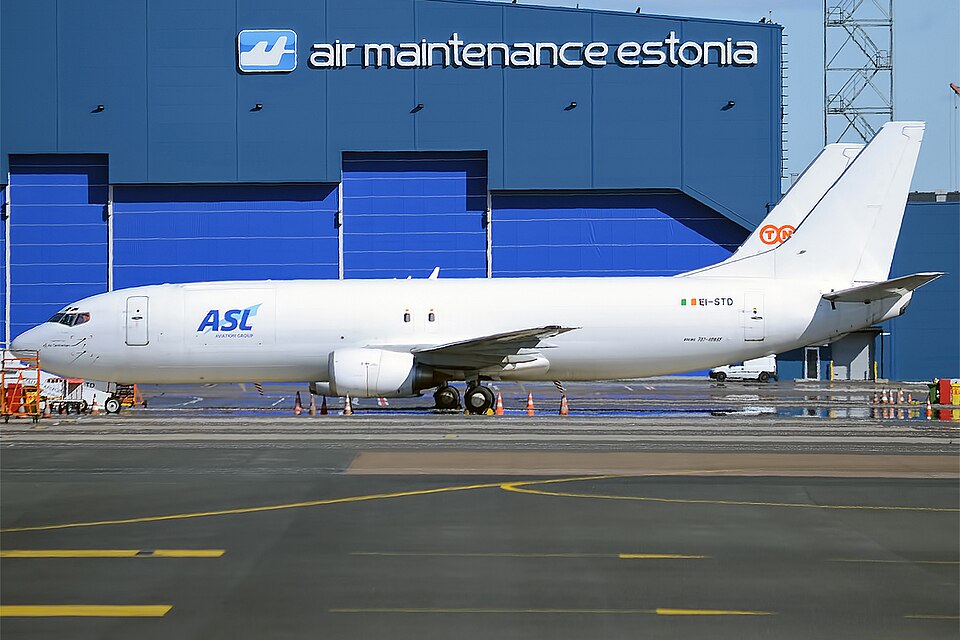
During the landing rollout at East Midlands Airport, as the Boeing 737-476(SF) cargo aircraft (registration EI-STD) slowed through 60 kt, the co-pilot handed control to the commander. The commander applied the brake pedals to disengage the autobrake system. The aircraft shuddered and rolled slightly left-wing-low as the lower part of the left main landing gear (MLG) detached. The MLG inner cylinder had fractured through its chrome-plated section, approximately 75 mm above the axle, allowing the left mainwheels and brake assembly to separate from the aircraft. The cause of the fracture was stress corrosion cracking and fatigue propagation within the high-strength steel substrate, leading to ductile overload failure. This was due to a small but significant area of localised heat damage to the chrome plating, which exposed the substrate to a corrosive environment. The exact source of the heat could not be determined.
History of the Flight
The aircraft was scheduled to operate three cargo sectors: from Athens to Bergamo, then to Paris Charles de Gaulle, and finally to East Midlands. The flap load relief system was inoperative, deferring the maximum flap setting to 30 degrees instead of 40. The co-pilot completed a pre-flight external inspection with no findings. The departure from Athens was uneventful, but factors at Bergamo (poor weather, lack of precision approach aids, and work in progress affecting landing distance) led the crew to route directly to Paris, where a normal landing was carried out.
The aircraft departed Paris for East Midlands at 0040 UTC with 10 tonnes of freight and 8 tonnes of fuel, with the co-pilot as pilot flying. During cruise, the crew obtained ATIS information indicating Runway 27 in use with a slight tailwind and Low Visibility Procedures (LVPs) in force. They planned for the commander to conduct a Category III autoland, but as weather improved and LVPs were cancelled, they rebriefed for an autopilot approach and manual landing by the co-pilot with Flap 30, Autobrake 2, and idle reverse thrust. The final ATIS reported wind 130/05 kt, visibility 3,000 metres in mist, and broken cloud at 600 ft. The aircraft was cleared to land with surface wind 090/05 kt. Touchdown was unremarkable, autobrake functioned normally, and the co-pilot applied idle reverse thrust.
As speed reduced through 60 kt, the co-pilot handed control to the commander. The commander made a brake pedal application to disengage the autobrake, but the system remained engaged. A second, more positive application followed, after which the aircraft shuddered and rolled left-wing-low as the lower MLG detached. The commander used the steering tiller to maintain direction, and the aircraft came to a halt slightly off the centreline, resting on its right MLG, the remains of the left MLG leg, and the left engine lower cowl. The co-pilot observed smoke. The commander shut down the engines and RFFS vehicles arrived.
Recorded Data
The aircraft was fitted with a 30-minute Cockpit Voice Recorder (CVR) and Flight Data Recorder (FDR) capturing over 40 hours of flying. However, due to parameter limitations and installation faults, no operational parameters for vertical forces, brake pressures, or autobrake usage were recorded. A Quick Access Recorder (QAR) suffered the same issues.
Takeoff occurred at 0040:46 UTC and touchdown at 0128:59 UTC. No heavy landing was indicated. Longitudinal acceleration during the roll was uniform until a brief spike at 52 kt groundspeed, followed 2.25 seconds later by a larger spike and high-frequency oscillations. After about one second, a clockwise control wheel input was recorded, corresponding to an attitude change to 7.7° left-wing-down and 3.7° nose-up pitch. The aircraft slowed to a stop over the next 10 seconds with longitudinal acceleration varying around -0.2 g. After stopping, the master caution triggered; recordings ended 11 seconds later. The last recorded attitude was 7.0° left-wing-down and 2.6° nose-up, with the nose gear weight-off indication. Thrust reversers were recorded as 'not deployed' before the oscillations; the right reversers registered 'lock' but left reversers remained 'unlock' due to the aircraft resting on the engine.
Aircraft Description
The Boeing 737-476(SF) is a low-wing, pressurised aircraft with retractable tricycle landing gear. Manufactured in 1990, it was originally in passenger configuration on the Australian register. Between November 2012 and February 2013, it was converted to Special Freighter (SF) configuration, transferred to the Irish Aviation Authority registry, and re-registered as EI-STD. During conversion, the left and right main landing gears were replaced with recently overhauled units. The aircraft held a valid Certificate of Registration and Airworthiness issued on 26 February 2013. Other than the inoperative flap load relief system, no significant defects were recorded.
Landing Gear and Autobrakes
The Boeing 737 MLG assemblies are located inboard of each engine nacelle and aft of the rear spar. Each consists of an outer and inner cylinder constructed from high-strength steel alloy. The inner cylinder carries the axle, wheels, and brakes, and slides within the outer cylinder via a gland seal. Torque links and an anti-shimmy damper prevent rotation. The autobrake system works with speed brakes and antiskid to provide braking without pilot pedal input. The aircraft was equipped with autobrake and antiskid systems, and the parking brake.
Communications
During the incident, communications between ATC and other agencies experienced some difficulties, including lack of clarity, non-standard terminology, confusion in lines of communication, and lack of prioritisation. The airport and relevant agencies reviewed these matters and took safety actions, which were summarised in the investigation report.