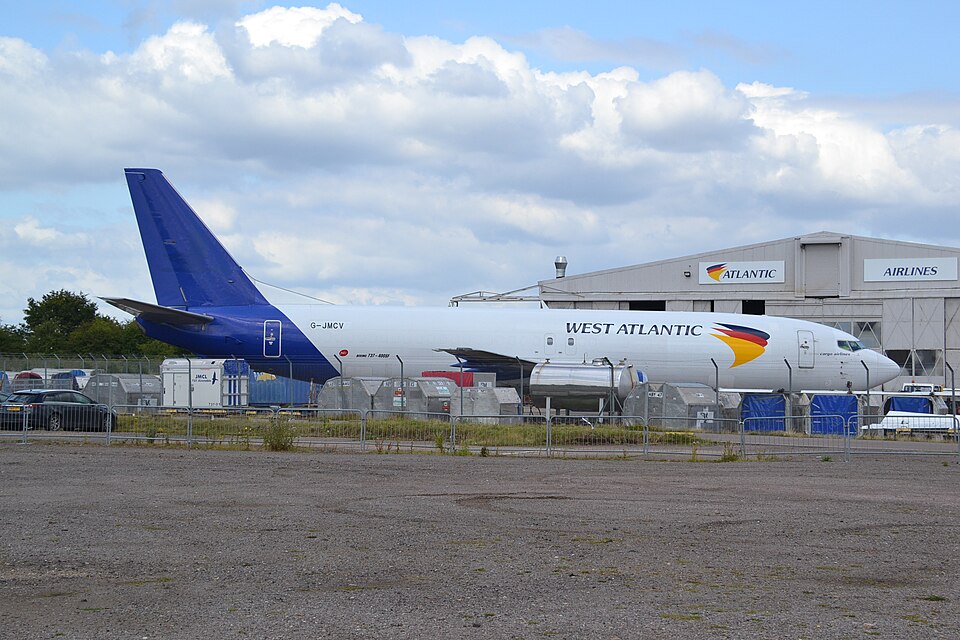
History of the Flight
The aircraft, a Boeing 737-4K5 registered G-JMCV, was operating a cargo flight from East Midlands Airport to Aberdeen Airport. The crew arrived at 0430 hrs and the commander decided de-icing was required. Two vehicles performed de-icing and provided receipts containing errors, which the commander asked the dispatcher to correct. When the dispatcher returned, he gave the commander several forms including the load sheet for the flight, de-icing receipts, and Notifications to Captain. The aircraft was being loaded during this time. The load sheet for the flight was checked, found correct, and acknowledged by the commander per the operator's Operations Manual. However, the sheaf of papers also contained a load sheet from a previous flight for the same aircraft. The crew inadvertently used figures from that incorrect load sheet to calculate takeoff performance using the manufacturer's Onboard Performance Tool (OPT). The incorrect load sheet indicated a mass approximately 10 tonnes lighter than the actual aircraft, so the aircraft was dispatched with inappropriate performance settings.
The taxi out was uneventful. After an engine run-up check due to low temperature, the commander, as pilot flying, commenced the takeoff run. He described the rotation as normal but both crew members felt a "small bump." They checked engine parameters and warnings; no issues were apparent. They completed the after-takeoff checklist and discussed possible causes, including a tail strike or a load shift. With no abnormal indications and normal handling, the commander decided to continue the climb to FL240. The co-pilot was inexperienced and under training, increasing the commander's workload.
The Operations Manual Part B (OMB) contains guidance: 'Should a load come loose, there is a serious risk to the aircraft. The deck angle must be maintained as stable as possible to avoid further movement.' In cruise, the commander asked the co-pilot to visually check the cargo hold. The load bay has three sectors (A, B, C). Bay B was empty; the commander was concerned cargo from Bay A could have moved aft. The co-pilot could only see Bay A, which appeared secure. The crew revisited the possibility of a tail strike and consulted the Quick Reference Handbook (QRH) tail strike checklist. Though the aircraft handled normally, the commander decided to action the tail strike checklist. The checklist directed depressurisation, but due to the co-pilot's inexperience, the commander descended to FL90 before depressurising. He checked fuel to confirm sufficient for Aberdeen at the reduced level. An ILS approach and landing at Aberdeen were uneventful. After shutdown, a walk-around revealed damage to the tail skid and a drainage mast.
Aircraft Performance
The crew used the OPT application to calculate takeoff performance, entering mass, centre of gravity, runway, and meteorological data. Both crew members made separate calculations to trap errors, but both used information from the previous flight. For the actual mass, the correct takeoff speeds, thrust, and stabiliser trim were different. The calculation used by the crew resulted in a rotation speed (VR) of 124 kt, compared to 139 kt for the actual mass. The thrust setting (N1) was 81.9% versus 86.8%. The stabiliser trim was more nose-up than correct.
Recorded Information
The Flight Data Recorder was not recovered, but data from the Quick Access Recorder (QAR) was analysed. The QAR showed elevator deflection to commence rotation at about 123 kt, consistent with the crew's calculated VR. The pitch attitude started increasing about 2 seconds after rotation initiation. Around 4 seconds after rotation initiation, the pitch rate peaked at 5°/s just before liftoff. Liftoff occurred at about 137 kt, approximately 5 seconds after rotation started, with a pitch attitude of 12.3°, exceeding the tail strike attitude of 11.4°.
Manufacturer's Information
The B737 Flight Crew Training Manual (FCTM) states: 'Above 80 knots, relax the forward control column pressure to the neutral position. For optimum takeoff and initial climb performance, initiate a smooth continuous rotation at VR toward 15° of pitch attitude.' A note says typical rotation rates are 2-3°/s, with liftoff attitude achieved in 3-4 seconds. The FCTM notes that factors increasing tail strike risk include mis-trimmed stabiliser, rotation at improper speed, trimming during rotation, excessive rotation rate, and improper use of the flight director. For a B737-400 with flap 5, liftoff should occur at 9.1° pitch attitude with 23 inches tail clearance; tail strike attitude is 11.4° with main wheels on the ground. If a tail strike is suspected, symptoms include a bump or jolt, scraping noise, or pitch rate stopping momentarily.
Analysis
The crew used data from a previous flight's load sheet, resulting in takeoff performance calculated for a mass 10,082 kg less than actual. The commander rotated at 123 kt instead of the correct 139 kt. The stabiliser trim was more nose-up, leading to lighter pitch control forces. The pitch rate peaked at 5°/s just before the tail struck the ground. Because airspeed was too low to generate sufficient lift for the actual mass, the aircraft did not lift off at the expected point; the tail contacted the ground during the continued rotation, damaging the tail skid and drainage mast.