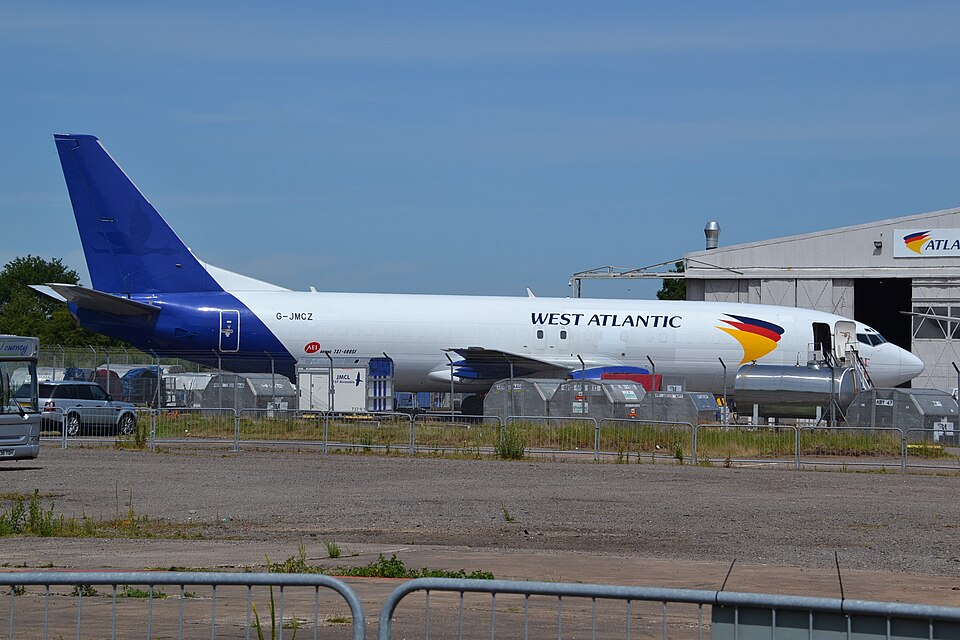
Incident Overview
On 26 April 2024, at 0030 UTC, a Boeing 737-4K5 cargo aircraft (registration G-JMCZ) was en route to Edinburgh Airport when the crew heard a "dull double bang" at the start of descent. The aircraft landed safely without further incident. Examination revealed minor damage to liner tape and paint on the forward bulkhead. No injuries were reported among the two crew members.
History of the Flight
The flight originated from London Stansted Airport. As the crew began their descent, they noted the unusual noise and a momentary higher vibration indication on the right engine, which had previous sporadic indications. The crew considered both an engine surge and a cargo shift. After completing their decision-making process, they continued to Edinburgh and landed without issues.
After parking, ground crew unloaded the main deck immediately and found that a unit load device (ULD) originally loaded in Bay B was located in Bay A. The crew were informed of the movement after unloading had begun, preventing a determination of whether the locks were not engaged or had malfunctioned.
Aircraft and Cargo Information
G-JMCZ is a Boeing 737-400 converted to cargo configuration in 2010, equipped with a cargo handling system and a forward bulkhead with a small sliding door and porthole window. The main deck has 11 bays (A to L). For this flight, cargo was loaded in Bays B through L, leaving Bay A empty (a void bay). The ULD in Bay B weighed 695 kg; total main deck cargo was 8,944 kg.
Examination and Weight Balance
Inspection found only minor damage to the bulkhead liner tape and paint; the bulkhead door, main door, and cargo handling system were undamaged. The operator's calculations showed that even after the shift, the aircraft centre of gravity remained well within manufacturer limits and the change was insignificant. The crew experienced no control or handling difficulties.
Organisational Procedures
The operator's Operations Manual Part B states the commander is responsible for cargo loading and security, but may delegate to qualified personnel. The load instruction form (LIR) is signed by the cargo handling person confirming secure loading. After this incident, the operator developed a new LIR clarifying responsibilities, including a section for signing off on void bay floor locks.
Visual inspection of cargo security is limited; once a ULD is loaded, it obstructs view of locks on previous items. Crew can attempt to move the foremost ULD but heavy items may not shift easily even if unlocked. In flight, the small bulkhead window provides limited visibility.
Void Bay Management
Void bays are recognized as a risk. The operator originally preferred void bays at the front for inspection. After this incident, a notice to crew changed the preference for the B737-400: a single void bay in Bay B is now considered lower risk than in Bay A, because the risk of ground crew forgetting to raise floor locks in Bay A is higher, and crew can push on the ULD in Bay A through the bulkhead door to check security.
Unloading and Findings
The operator had no specific procedures for ground crew to check cargo movement before unloading. The ULD was found shifted from Bay B to Bay A, indicating it had moved forward during descent, likely due to unsecured locks.
Analysis and Conclusion
The analysis concluded it is likely that during loading of the ULD in Bay B, some or all locks were not secured, allowing it to move forward into the void Bay A when the aircraft pitched for descent. The operator's safety actions addressed these risks.
Safety Actions
The operator took the following actions:
- Issued a notice to crew on load shift awareness and void bay management.
- Changed guidance to move a single void bay from A to B on the B737-400.
- Convened a Safety Action Group to review procedures and issued a revised LIR clarifying responsibilities and requiring signatures for void bay lock status.