Summary
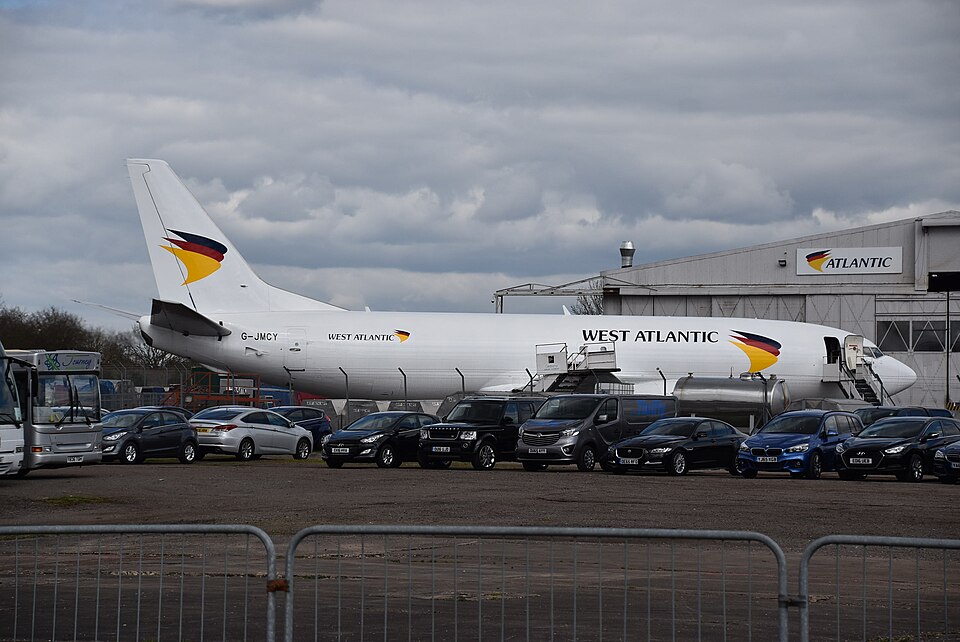
On 19 January 2021 at 0237 UTC, a Boeing 737-4Q8, registration G-JMCY, conducting a commercial cargo flight, sustained substantial damage following a hard landing at Exeter Airport, Devon. The aircraft, operated by an unnamed airline, had two crew members on board and no passengers. No injuries were reported.
History of the Flight
The crew were scheduled to operate two cargo flights between Exeter Airport and East Midlands Airport (EMA). The co-pilot was the pilot flying (PF) for both sectors, which were conducted at night. The initial sector from EXT to EMA was uneventful, and the aircraft landed with FLAP 40.
During the return flight, the crew calculated landing performance using the aircraft manufacturer's software. Runway 26 was forecast to be wet, so they planned to use FLAP 40 with AUTOBRAKE 3. The approach brief mentioned the 3.5° glideslope but did not address differences in stabilised approach criteria. The ATIS indicated weather better than forecast with a surface wind from 230° at 11 kt.
ATC provided radar vectors to the ILS for Runway 26. The landing gear was lowered and FLAP 25 selected before intercepting the glideslope. FLAP 40 was selected just below 2,000 ft amsl. The crew became visual with the runway at about 1,000 ft aal, and the PF disconnected the autopilot and autothrottle. At 500 ft radio altimeter (RA), the approach was declared stable. However, the rate of descent (ROD) was approximately 860 ft/min and soon exceeded 1,150 ft/min. At 320 ft RA, the aircraft deviated below the glideslope, and a GPWS "SINK RATE" alert sounded. Further alerts occurred at 150 ft RA and during the final moments before touchdown. The aircraft landed hard, triggering a "PULL UP" warning. After landing, the commander took control and taxied the aircraft to the stand, where a hydraulic leak was discovered.
Crew Information
The commander, aged 56, held an Air Transport Pilot's Licence and had 15,218 total flying hours, including 9,000 on the Boeing 737. The co-pilot had 19,350 total flying hours, with 5,637 on the Boeing 737. Fatigue was assessed and found not to be a factor.
Aircraft Information
The aircraft, a Boeing 737-4Q8 (serial no. 25114, year of manufacture 1994), was powered by two CFM56-3C1 turbofan engines. Weight and balance were within limits. The landing weight was approximately 52,900 kg with 6,600 kg of fuel remaining. The aircraft was damaged beyond economical repair.
Other Information
The ILS approach for Runway 26 at Exeter has a 3.5° glideslope. The airport operator confirmed that runway lights, ILS, DME, PAPIs, and pressure sensors were serviceable after the event. The operator has since taken safety action to reinforce stable approach criteria and introduced procedures to monitor pilot performance trends.