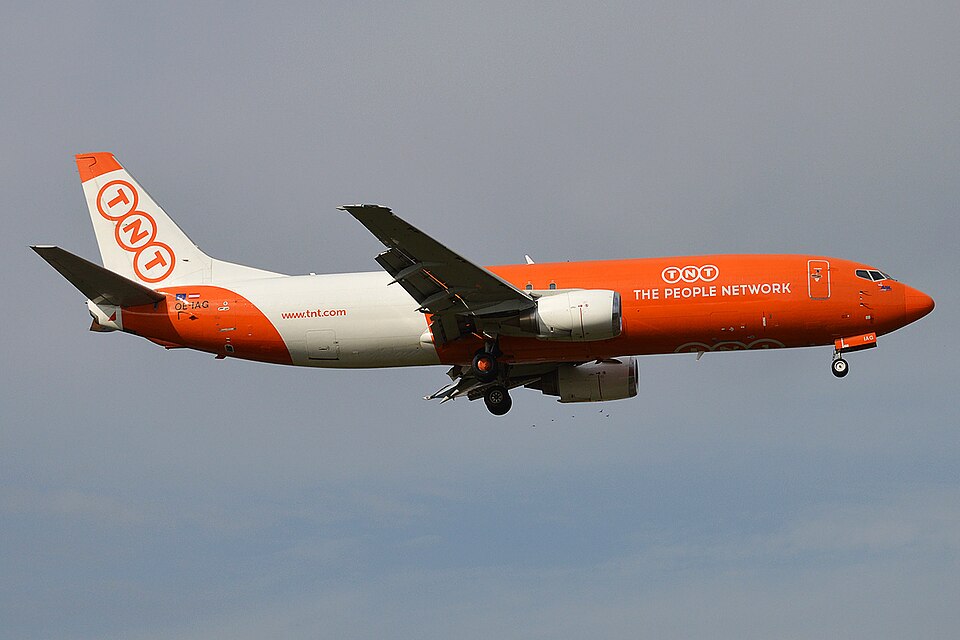
History of the Flight
The aircraft departed East Midlands Airport carrying 16 tonnes of cargo. It landed on Runway 25 at Belfast International Airport at a weight of 54,900 kg (98% of maximum landing weight) with a forward but within-limits centre of gravity. At touchdown, the tailwind component was 5 kt and crosswind 10 kt from the left. The aircraft touched down about 250 m beyond the threshold. The crew did not recall anything unusual about the touchdown. After speedbrake deployment, thrust reversers and brakes were selected. A vibration developed and increased, leading the crew to suspect a tyre failure. The anti-skid fail warning illuminated; the crew cancelled thrust reversers and automatic braking as sufficient runway remained. The aircraft oscillated near the centreline before stopping 2,170 m beyond the threshold at the intersection with Runway 17/35. No injuries occurred, and the aircraft was moved from the runway at approximately 1800 hrs.
Aerodrome Information
Belfast International Airport (Aldergrove) has two intersecting runways: Runway 07/25, 2,780 m long, and Runway 17/35, 1,891 m long.
Meteorological Information
METAR reports around the time of the accident indicated a surface wind from 130° at 9–11 kt, giving a tailwind of about 5 kt and a crosswind of about 10 kt from the left for Runway 25. The Met Office noted that if the wind at 2,000 ft was 35 kt, vertical wind shear would be 12 kt/1,000 ft, meeting criteria for severe turbulence. The aircraft manufacturer calculated a tailwind of 5 kt from 1,000 ft to touchdown and a crosswind dropping from 30 kt at 1,000 ft to about 10 kt at touchdown.
On-site Investigation
The aircraft came to rest on Runway 25 at its intersection with Runway 17/35. Parallel tyre marks with a distinctive S-shaped pattern were observed to the right of the runway centreline, starting approximately 900 m from the threshold and continuing to the right main landing gear (MLG) wheels; the last 60 m of marks were straight. Inspection revealed both wheels of the right MLG were skewed, with significant damage to both wheel hubs and tyres, though both tyres remained inflated. The lower torsion link on the right MLG was fractured. Debris included pieces of bushings from the apex where the upper and lower torsion links join. The shimmy damper link condition could not be accurately assessed due to damage.
Recorded Information
Flight data recorder (FDR) and cockpit voice recorder (CVR) data were analysed. During descent through 1,000 ft, the aircraft was configured with flaps 30, autopilot and auto throttle disengaged. Calibrated airspeed was about 148 kt (VREF+7), with a tailwind component of about 5 kt and crosswind component of about 30 kt from the left. Below 500 ft, descent rate was about 800 ft/min, reducing to 600 ft/min at touchdown. Touchdown occurred with 1.7° left bank, a drift angle of 3° to the right, at about 148 kt CAS and a peak normal acceleration of 1.65 g. During rollout, speed brakes deployed on touchdown, thrust reversers fully deployed by 530 m beyond threshold. At about 690 m, the air/ground discrete erroneously changed to air, followed by lateral acceleration oscillations. Brakes were applied at 950 m, temporarily released when thrust reversers were stowed. The aircraft oscillated and stopped at 2,170 m.
Aircraft Information
The Boeing 737 MLG is a cylinder/piston shock-strut. A scissor linkage (upper and lower torsion links) prevents rotation of the inner piston relative to the outer cylinder while allowing axial movement. A shimmy damper connects between the apexes of the torsion links to control rotary oscillation. The lower torsion link apex connects to the damper piston rod via a bearing assembly with spherical bushes and thrust washers.
Assessment of Fractured Torsion Link
Metallurgical examination of the fractured lower torsion link indicated overload failure with no fatigue. The failure was caused by shimmy.
Maintenance Records
The torsional free play check between inner and outer cylinder had last been successfully completed (date not specified). Wear in the bushings was present but not considered significant by the manufacturer compared to previous causal events.