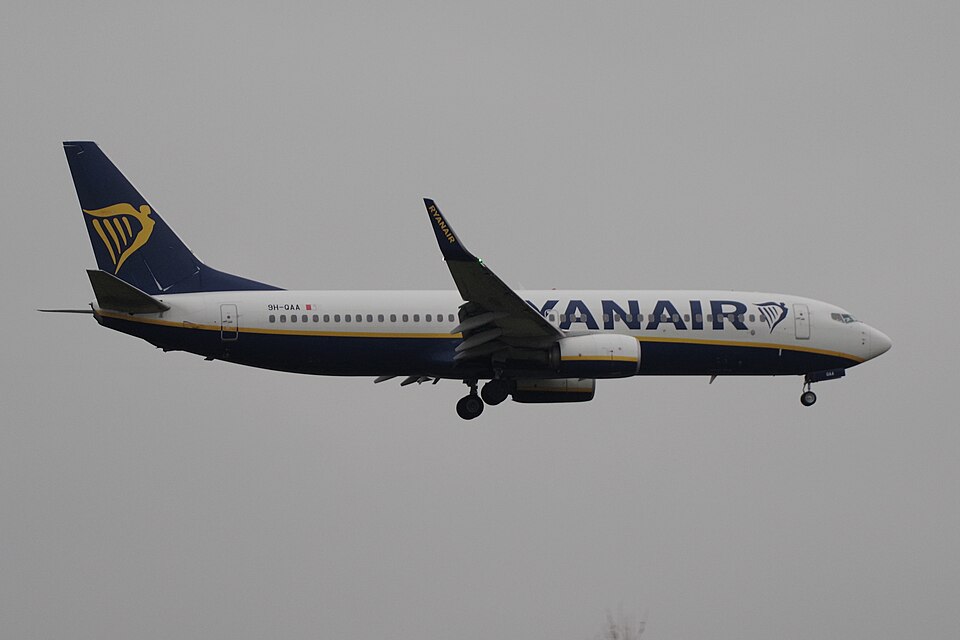
Incident Overview
On 21 August 2024 at 0808 UTC, a Boeing 737-8AS registered 9H-QAA was involved in an accident while being pushed back from Stand 63R at London Stansted Airport. The aircraft, operated on a commercial passenger flight to Venice Marco Polo Airport, had 6 crew and 181 passengers on board. None were injured. The tail cone, tail fuselage, and APU sustained damage.
Pushback Sequence
The pushback was performed by a ground crew consisting of a headset operator, a wingman, a tug driving instructor, and a trainee tug driver. The flight crew had requested a remote hold due to an ATC slot time of 0840 hrs, and ATC cleared a long pushback to the end of the cul-de-sac on Apron Delta. The initial pushback by the trainee driver involved several corrective turns, prompting the commander to inquire over the interphone. The trainee then stopped and swapped seats with the instructor, who resumed the pushback.
As the aircraft's nosewheel reached the 'Tug release point' (TRP) ground markings, the tug was expected to stop. However, it continued at idle engine power beyond the TRP and collided with the blast barrier at the end of the cul-de-sac. The instructor then pulled the aircraft forward off the fence and stopped.
Ground Crew Actions
The tug instructor reported focusing on speaking to the trainee and stated that the TRP was not very prominent and obscured under the aircraft's fuselage. He also noted that because the aircraft's engines had not been started, there was no thrust opposing the tug's idle power. The trainee driver felt the tug slow near the TRP but did not question the instructor's actions. The headset operator assumed the instructor had a reason for continuing, and the wingman, who lacked marshalling wands, realized the aircraft had passed the TRP only moments before impact. No warning signals were given.
Airport Safety Actions
Following the accident, the airport operator increased the length of TRP markings from 0.5 m to 1 m and painted them on both sides of the taxiway centerline to improve visibility. The ground handling agency issued a reminder to all staff about TRP procedures and incorporated this into training modules.
Human Performance Considerations
The incident highlights challenges in maintaining situation awareness during training in a dynamic environment. The instructor's focus on the trainee and the absence of engine start during pushback may have contributed to the overshoot. Startle and surprise likely influenced the instructor's immediate action of pulling the aircraft forward, rather than leaving it in place.