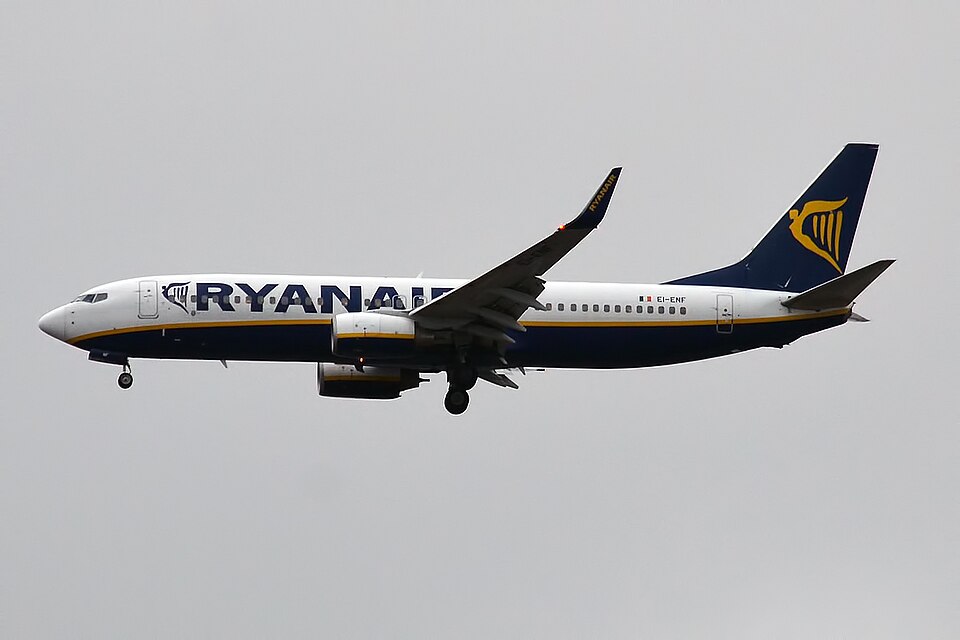
Incident Overview
On 17 March 2022, a Boeing 737-8AS (registration EI-ENF) experienced a serious incident while taxiing to the gate after landing at Manchester Airport. The outboard wheel on the left main landing gear failed due to a fatigue crack in the wheel hub, leading to a hydraulic leak and subsequent fire. There were no injuries to the 6 crew and 167 passengers on board.
Flight History
The aircraft made a normal approach and landed on Runway 23R. After landing, the crew received clearance to taxi to a stand at Terminal 3. During taxi, the crew noticed that maintaining normal taxi speed required approximately 40% N1 thrust, higher than usual. Suspecting a flat tyre, they continued taxiing. Approaching the stand, the crew heard a radio transmission requesting fire services for an aircraft with brakes on fire. Realising the call referred to their aircraft, they completed the parking procedure, shut down the engines, and issued a standby call to the cabin crew. The fire service extinguished the fire around the left main landing gear. The flight crew deemed an emergency evacuation unnecessary, and passengers disembarked normally.
Recorded Information
Data from the quick access recorder showed that the approach, landing, and brake application were normal. Taxiway cornering speeds were below 10 kt. CCTV footage revealed that the fire started as the aircraft turned left from the apron towards the gate.
Aircraft Examination
Examination by the operator's engineering personnel found that the left main wheel inner hub had fractured. The resulting wheel misalignment damaged the brake piston, causing a hydraulic fluid leak. Heat generated by the misaligned wheel during taxi ignited the hydraulic fluid. The wheel manufacturer subsequently identified that the inboard wheel hub had fractured radially in four locations, along with a circumferential crack. Three of the four radial fractures and the circumferential fracture were consistent with overload. A fatigue crack was found on one fracture surface, originating at a corrosion pit located on the lead-in chamfer of the inner wheel half bearing bore. Additional fatigue cracks from corrosion pits were also found in the bore.
Related Occurrences
The operator experienced a similar event in Spain, which is under investigation by the Spanish Comisión de Investigación de Accidentes e Incidentes de Aviación Civil (CIAIAC).
Safety Actions
In response to the wheel hub failures, the wheel manufacturer developed an ultrasonic inspection technique to assess the internal bore of the wheel hub for cracks originating at the lead-in chamfer of the bearing bore. The operator has incorporated this optional ultrasonic inspection into their maintenance programme for their fleet of Boeing 737-8AS aircraft. The manufacturer has stated they will amend the component maintenance manual to include this inspection.