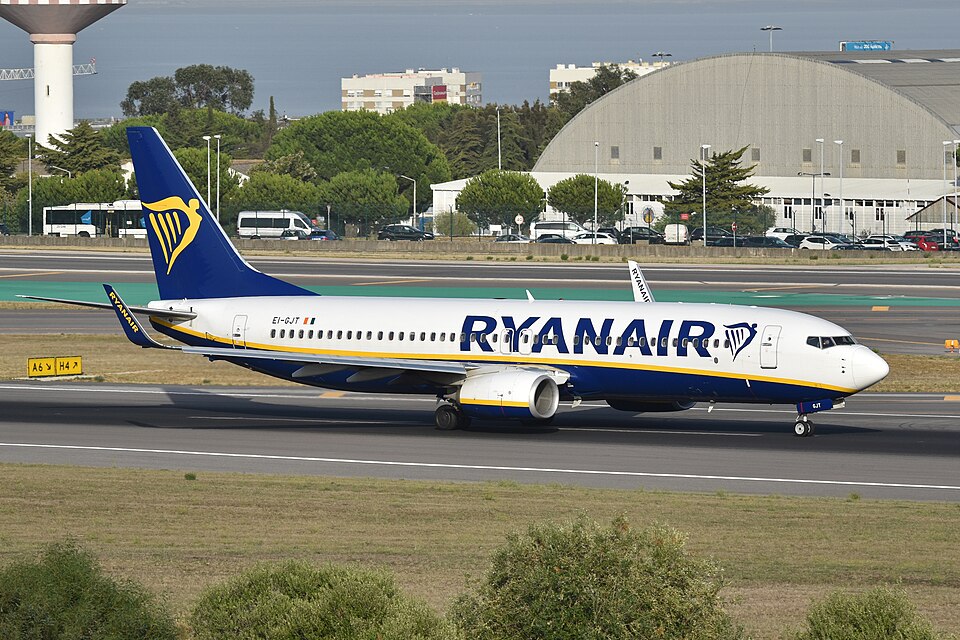
Incident Overview
A serious incident occurred on 9 October 2018 involving a Boeing 737-8AS (registration EI-GJT) during a commercial passenger flight from Porto Airport, Portugal to Edinburgh Airport. The aircraft, with 6 crew and 177 passengers aboard, experienced a malfunction of the commander's attitude indicator shortly after reaching cruise altitude. No injuries were reported and no damage was sustained. The aircraft landed safely at Edinburgh after being flown manually.
History of the Flight
The crew operated the sector into Porto without technical issues and conducted standard turnaround procedures for the Inertial Reference System (IRS). Departure was at 1953 UTC and takeoff at 2000 UTC. The climb to FL360 was uneventful. While in cruise, shortly after entering the Brest Flight Information Region, the aircraft began a slow, un-commanded pitch up and climbed to approximately FL366. The autothrottle minimum speed protection activated, increasing thrust to about 95% N1 as speed decayed below minimum manoeuvring speed. The commander's Primary Flight Display (PFD) initially indicated a pitch attitude of around 10° nose-up, though the crew perceived a lower attitude. An altitude warning sounded. The commander deselected the autopilot and autothrottle and manually recovered the aircraft to level flight using standby instruments.
Subsequently, the commander's attitude indicator showed a slow roll to approximately 60° left angle of bank. Yellow pitch, roll, and flight path vector comparator annunciations appeared on both PFDs. The co-pilot's instruments remained serviceable. The aircraft descended to FL357 before returning to FL360. The crew consulted the Quick Reference Handbook (QRH) and Flight Crew Operating Manual (FCOM) but found no applicable checklist. They then engaged the co-pilot's autopilot. The crew attempted lateral navigation mode but the autopilot did not operate correctly, so they used heading select mode and continued with manual thrust.
Approximately 10 minutes later, autopilot B disconnected and the Master Caution System illuminated with an IRS caution. The crew identified a left IRS fault indication on the IRS Mode Select Unit (MSU). Following the QRH 'IRS Fault' checklist, they selected ATT mode on the MSU. Although the fault light cleared, the IRS continued to provide erroneous attitude data due to a faulty accelerometer. The crew flew manually, sharing duties, and elected to continue to Edinburgh.
Arrival and Landing
For arrival at Edinburgh, weather conditions included a moderate south-westerly wind gusting to 30 kt, good visibility, and no cloud below 3,000 ft. The crew declared a PAN and informed air traffic control of autopilot issues. During the approach, they experienced erroneous airspeed and windshear warnings, and the autobrake system would not arm. The co-pilot noted unexpected roll characteristics, but the crew controlled the aircraft satisfactorily. They conducted an ILS approach and landed uneventfully using manual braking, then taxied to the stand.
Recorded Information
The flight data recorder (FDR) and cockpit voice recorder (CVR) were analyzed. The FDR data showed that at 2039 UTC the left IRS latitude and longitude began to drift, with a corresponding 250 kt jump in indicated groundspeed. The aircraft climbed to FL367, N1 increased to 95%, pitch increased, and airspeed decreased below 232 kt triggering a minimum speed warning. The left IRS calculated erroneous attitude, heading, and groundspeed, with pitch attitude increasing to 90° and heading changing nearly 180° over about 20 minutes until the system indicated invalid attitude. The drift was driven by an along-track acceleration of approximately 1.6 g.
Aircraft Description
The aircraft was a Boeing 737-800, manufactured in 2018 with 1,705 flight hours and 890 cycles. It was equipped with two Air Data Inertial Reference Units (ADIRUs). The left IRS suffered a transient fault in one of its accelerometers, leading to erroneous position calculation. This false position information resulted in incorrect attitude on the commander's PFD and caused the autopilot to initiate a slow climb.
Investigation Outcome
The investigation identified that the left IRS accelerometer fault caused the attitude indicator malfunction. One Safety Recommendation was made concerning the Boeing 737 QRH.