Incident Overview
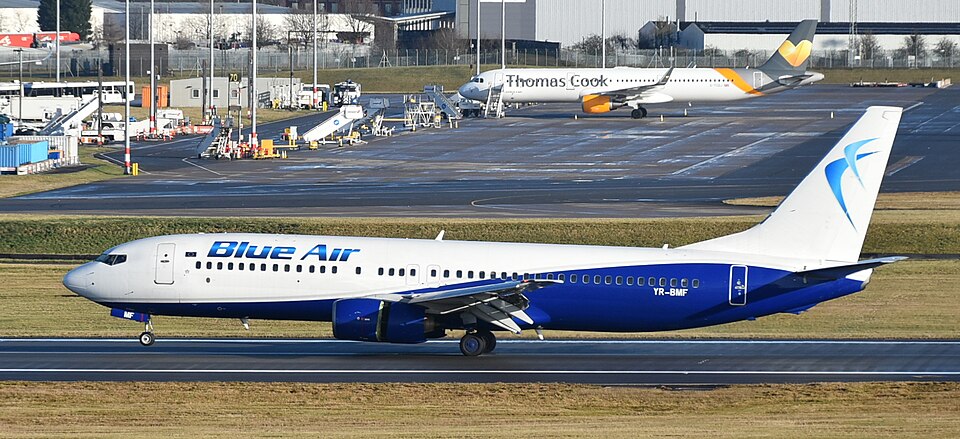
On 28 July 2018, a Boeing 737-8Q8 (registration YR-BMF) operating a scheduled passenger flight from Birmingham Airport to Bucharest International Airport experienced a tailstrike during takeoff. The aircraft, powered by two CFM56-7B24/3 turbofan engines, had 6 crew and 190 passengers on board; no injuries were reported. The tailstrike caused damage to the APU drain mast and tail skid components.
History of the Flight
The flight was a turnaround service from Bucharest, with the co-pilot flying his first sectors since passing his line check the previous day. The commander was the pilot flying. During the turnaround, the dispatcher advised of a calculated takeoff time (CTOT) 54 minutes after the scheduled departure time; however, the crew planned to depart on time. The co-pilot prepared the flight management computer (FMC) and electronic flight bag (EFB) while passengers boarded. Loading delays resulted in the load sheet arriving around the CTOT. To save time, the commander read figures from the load sheet to the co-pilot, who entered them into the EFB. The performance data was then entered into the FMC without crosschecking. The aircraft was cleared to start and taxi to Runway 15, with wind from approximately 210° at 14 kt, gusting 31 kt.
Takeoff Data Error
The commander inadvertently read the zero fuel weight (ZFW) instead of the takeoff weight (TOW) from the load sheet. As a result, the EFB calculated takeoff performance using a weight of 59 tonnes instead of the actual 71.3 tonnes. This produced significantly lower takeoff speeds: V1 of 140 kt (correct 152 kt), VR of 140 kt (correct 153 kt), and V2 of 143 kt (correct 157 kt). The crew used these incorrect speeds for takeoff. Recorded data showed the aircraft began rotation at about 143 kt, reaching a pitch attitude of 11.95° nose-up with a peak pitch rate of 4.2°/second. The manufacturer’s training manual states the tailstrike pitch attitude for the 737-8 is 11.0°.
Crew Response and Discovery
After takeoff, a ground operations witness reported to air traffic control (ATC) that the aircraft’s tail came very close to the runway. ATC asked the pilots if they had sustained a tailstrike. The pilots, having noticed nothing unusual and after checking aircraft systems (including pressurisation), replied no. They continued to destination. During the cruise, the commander checked the EFB and realised the weight error. He then asked cabin crew if they had noticed anything during takeoff; the rear cabin crew member reported hearing a strange noise but could not identify it. Despite these anomalies—the ATC query, the EFB error, and the strange noise—the crew did not action the tailstrike checklist. After landing in Bucharest, the commander asked engineers to inspect the aircraft, revealing the damage to the tail skid and APU drain mast.
Operator's Actions
Following the incident, the operator issued Safety Information Bulletin No 7/2018 to pilots, emphasising strict adherence to procedures for independent performance calculations and crosschecking, the importance of information from cabin crew and ATC, and the requirement to use the Quick Reference Handbook (QRH) for any non-normal situation, including a suspected tailstrike.
Probable Cause
The takeoff performance data was calculated using the zero fuel weight instead of the takeoff weight, resulting in lower takeoff speeds and a tailstrike.