History of the Flight
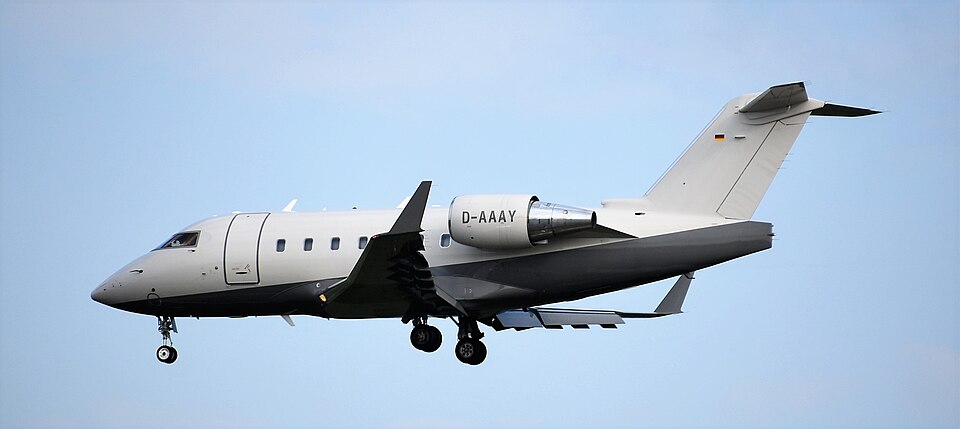
On 10 August 2022, at 1618 hrs, Bombardier CL-600-2B16 (604 Variant) D-AAAY departed Farnborough Airport, Hampshire, on a commercial passenger flight to Málaga. The crew used flap 20 for takeoff and selected flap 0 after retraction. As the aircraft climbed through FL190 at approximately 300 KIAS with autopilot engaged, a 'flaps fail' caution appeared on the EICAS primary page. The copilot, who was pilot flying, reported a nose-up pitch and deceleration. The flap position indicator showed an animated green bar indicating flap extension. The crew noted the flap lever remained at 0. The commander took control, disengaged autopilot, reduced thrust, and initiated a descent. They informed ATC, descended to FL150 at 180 KIAS (below VFE for flap 45), and diverted to Farnborough. A flight attendant visually confirmed flaps fully extended and symmetrical. The crew followed the 'FLAPS FAIL' procedure and landed on Runway 06 at 1651 hrs without further incident. No injuries were reported.
Meteorology
High pressure over southern UK brought clear, dry, and warm conditions, with stable weather at Farnborough during the event.
Aircraft Information
The Bombardier CL-600-2B16 (604 Variant), registration D-AAAY, was manufactured in 2004 (serial number 5602). It was powered by two General Electric CF34-3B turbofan engines. The aircraft was configured for commercial air transport with 3 crew and 7 passengers on board.
Flap System Description
The flap system consists of two double-slotted panels per wing, controlled by a Flap Control Unit (FCU) via a cockpit lever. Four extend/retract relays (one per motor channel) command two 200 V AC motors. Relays contain four contact sets (A, B, C, D). Contacts A, B, C switch 115 V AC to motors; D contacts switch 28 V DC to Brake Detector Units (BDUs). The relays are commercial off-the-shelf components; the relay manufacturer changed contact material in 1993.
Investigation Findings
The investigation determined that the No 1 flap retract relay had a latent failure present for at least 64 flights before the incident. This failure caused the flaps to retract at half speed and prevented the arrest of an uncommanded movement. The failure resulted from damage to the D contacts due to electrical arcing from unsuppressed back-EMF generated when BDUs de-energised. However, the root cause of the uncommanded flap movement during the flight could not be established.
Safety Actions
The AAIB published two Special Bulletins (S2/2022 and S1/2023) with four safety recommendations. Transport Canada and Bombardier Aviation have taken and planned additional safety actions in response.