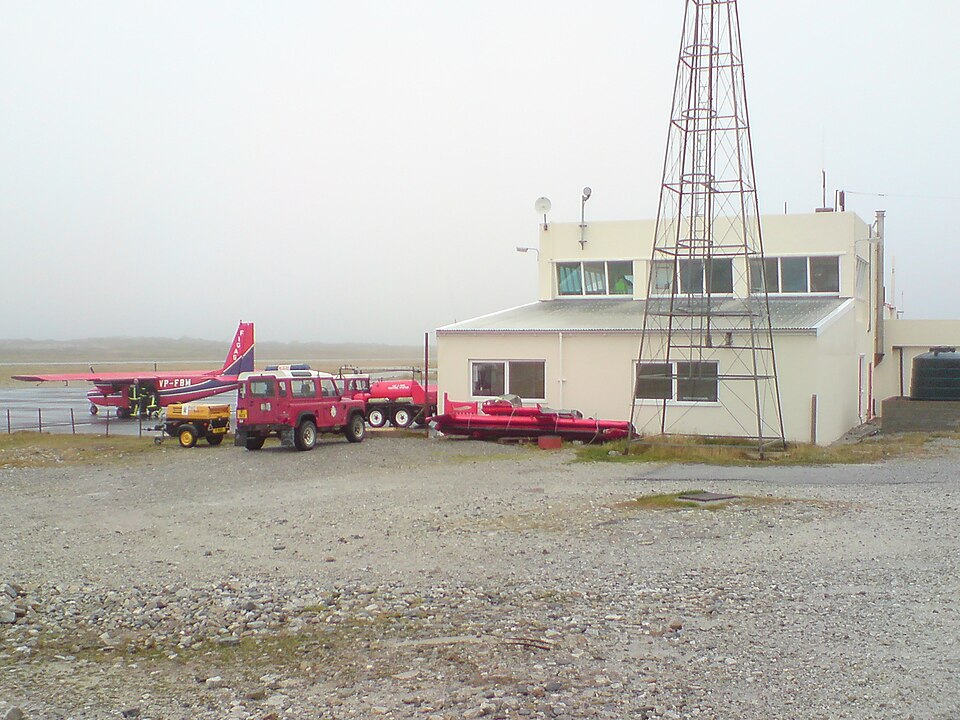
History of the Flight
The aircraft, a Britten Norman BN2B-26 Islander (VP-FBM), was conducting a commercial air transport passenger flight between airfields on Weddell Island and Beaver Island, a distance of about 12 minutes. The single pilot had 16,635 hours of flying experience, with 16,030 hours on type. This was his first day back after leave, having returned to the Falkland Islands the previous day. He reported being well rested.
While en route, the pilot expected to land on Runway 13 at Beaver Island due to a southerly wind at departure. However, upon contacting the destination, he was informed that wind conditions favored Runway 27. He repositioned the aircraft and rolled out of the final turn on short final.
Video footage from passengers showed that about 8 seconds after rolling out onto final, the stall warning horn sounded, followed by a hard impact. The pilot reported feeling the right wing drop just before impact.
Inspection revealed marks from the left wheel on a small bank about 14.5 m short of the start of the runway undershoot area, and from the right wheel about 12.4 m short. Further marks indicated the aircraft struck additional banks before both wheels contacted the ground 3.5 m inside the undershoot area. During the landing roll, the aircraft veered right but the pilot maintained control, taxied clear, and shut down. Significant damage was found to the right landing gear, engine mounts, and wing.
Airfield Description
Beaver Island has a main strip, Runway 13/31 (414 m x 20 m), and a secondary strip, Runway 09/27 (287 m x 18 m). Thresholds are marked with L-shaped white markers, and sides with white markers at 60 m intervals. Each strip has 30 m undershoots marked by red and white markers, deemed safe for aircraft manoeuvres. Local wind effects can occur due to surrounding topography. The crosswind limit is 20 kt.
Weather
The pilot reported wind from the south-west at about 20 kt, requiring use of the secondary strip, with a crosswind of about 15 kt. Visibility was about 8 km in mist with a cloud base of about 400 ft.
Conclusions
The evidence indicates it is likely the aircraft stalled or suffered an unexpected descent on final approach at low height, just short of the undershoot area. This was probably caused by a combination of low approach speed (necessary for the short strip) and turbulence or windshear from local topography under prevailing wind conditions. The pilot noted that the stall warner often sounds just prior to touchdown and did not necessarily indicate a full stall. Despite the challenges, the pilot was experienced and capable. The pilot was confident fatigue was not a factor. He commented that late repositioning due to the runway change may have contributed to handling just prior to touchdown. As a result, the operator conducted a review and decided to level some banks short of the undershoot areas as a precaution.