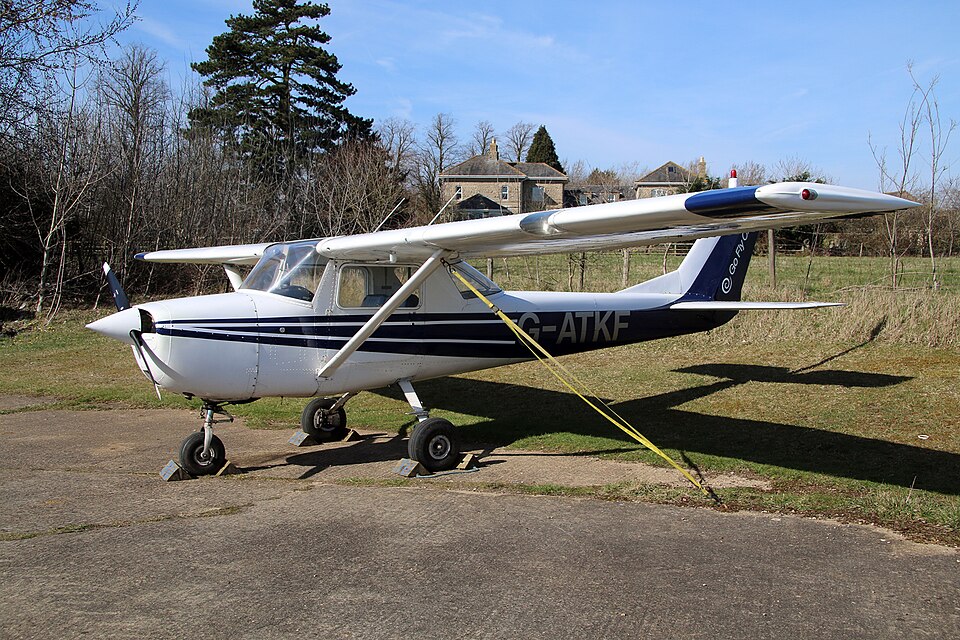
On September 4, 2015, a Cessna 150F (registration G-ATKF) was involved in an aviation accident near Hinton-in-the-Hedges Airfield, Northamptonshire, GB. Investigators recorded the probable cause as: The pilot extended the flaps during a go-around after a bounced landing and did not control the natural tendency for the aircraft to pitch up, resulting in a stall and spin from which there was insufficient height to recover. This summary draws on records from the UK Air Accidents Investigation Branch (AAIB).
A student pilot was killed when a Cessna 150F, G-ATKF, entered a spin after a bounced landing and go-around at Hinton-in-the-Hedges Airfield on 4 September 2015.
Accident Overview and Aircraft Details On 4 September 2015 at 1110 UTC, a Cessna 150F with registration G-ATKF was destroyed in an accident at Hinton-in-the-Hedges Airfield in Northamptonshire. The aircraft, manufactured in 1965 with serial number 150-62386, was powered by a single Continental Motors Corp O-200-A piston engine. It was a two-seat, high-wing monoplane configured for dual control and used for general aviation and Private Pilot’s Licence (PPL) training. The aircraft had accumulated 12,632 airframe hours, with its most recent 50-hour check completed on 18 August 2015. No deferred defects were recorded in its technical logs. ## Flight History and Sequence of Events The pilot was a 39-year-old solo student with 33 total hours of flying experience, all on type, and was undergoing training for a PPL. The flight was a solo consolidation exercise for glide approaches. Earlier that morning, the student had completed six glide approaches with an instructor. Weather conditions included a wind from 320° at 7 kt, broken cloud at 4,000 ft amsl, visibility over 10 km, and a temperature of 16°C. Witnesses on a raised platform observed the aircraft making two or three circuits on Runway 24 before the final approach. The aircraft touched down on its nose gear, sat back onto its main gear, bounced, and floated along the runway before touching down again with the left main gear first. After settling, the pilot applied power for a go-around. The aircraft lifted off into a level attitude with a slight climb. The pilot extended the flaps, but the aircraft began to pitch up into a steep nose-up attitude. It then banked to the left, stalled, and entered a spin from which there was insufficient altitude to recover. The aircraft struck the ground in a steep nose-down attitude. ## Accident Site and Damage The aircraft impacted a stubble field 230 m from the end of the concrete runway surface. It struck the ground nose-down at an estimated angle of 10 to 15° from the vertical, leaving a 150 mm deep impression in the dry, stony soil. The nose landing gear detached, and the aircraft fell back to rest upright on its main landing gear, which was displaced, twisted, and folded underneath the fuselage. One propeller blade was curved forward, while the other showed slight tip distortion and deep nicks. The cockpit instrument panel and coaming were caved in, and the altimeter was found set at 1016 hPa. The wing had twisted, and both wingtip leading edges were crumpled. The flaps were found down and rigidly in position at 38° extension. ## Technical Findings and Pilot Information Detailed examination revealed that the stall warning system was serviceable and produced a normal tone when tested. The flap linkages and drive system were undamaged, and the flap switch and wiring were found to be serviceable. An alteration had been made to the fuse panel, where a 60 amp breaker was fitted in the slo-blo location and labelled 'alt', while the flap fuse holder was relocated and relabelled 'flap'. The post-mortem examination found no evidence of natural disease sufficient to cause or contribute to death, though medical incapacitation could not be excluded. The pilot died from a head injury resulting from deceleration forces. Toxicology reports showed no evidence of drugs, alcohol, or significant carbon monoxide exposure. The student had begun flying on 6 June 2015 and first flew solo on 17 August 2015 after 22 hours of instruction. His training with 40° of flap was limited to a demonstration, and his go-around experience had been with 20° or 30° of flap, not 40°.
Probable cause
The pilot extended the flaps during a go-around after a bounced landing and did not control the natural tendency for the aircraft to pitch up, resulting in a stall and spin from which there was insufficient height to recover.