Accident Overview
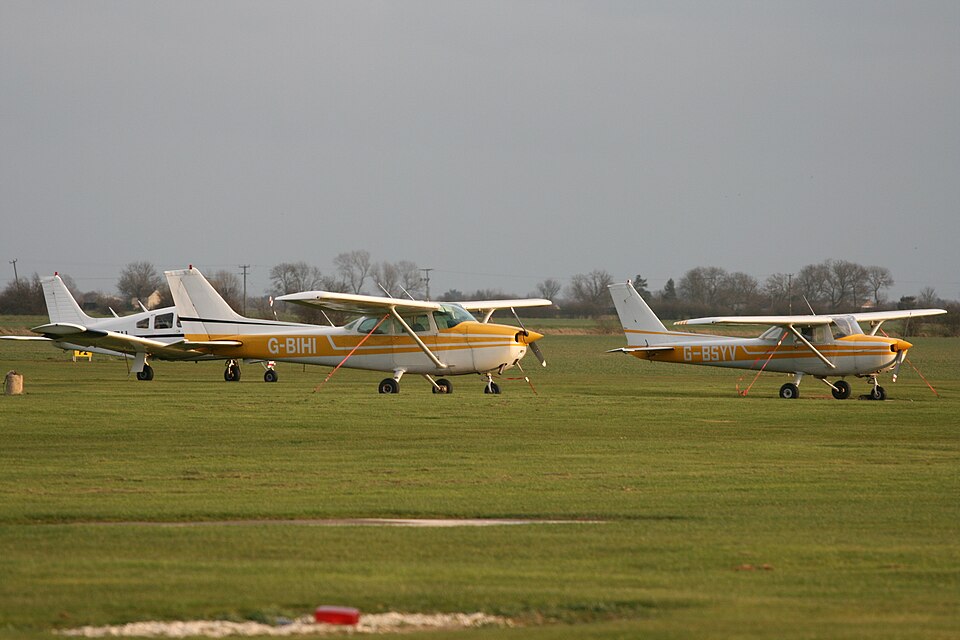
On 18 September 2014 at 1400 UTC, a Cessna 172M Skyhawk (registration G-BIHI) sustained damage to its nose landing gear and propeller during a landing accident at Fenland Airfield, Lincolnshire. The aircraft was manufactured in 1976 and powered by a single Lycoming O-320-E2D piston engine. The private flight carried one pilot and one passenger; neither reported injuries.
Pilot Information
The 53-year-old pilot held a Private Pilot’s Licence and had accumulated 160 total flying hours, including 6 on type. In the preceding 90 days she had flown 4 hours, and in the last 28 days, 1 hour.
History of the Flight
The pilot planned a local flight lasting about one hour. Upon departure, surface wind was 10 kt from 310°, visibility was approximately 5,000 m with some haze, and there were few clouds at about 2,000 ft. After flying north, the pilot observed a lowering cloud base and worsening visibility, prompting a decision to return to Fenland.
Runway 36, a grass strip 600 m in length, was in use. The pilot flew a downwind join but, due to the reducing visibility, kept the circuit closer to the airfield than normal. This, combined with only a light headwind on final approach, resulted in the aircraft being higher than usual on final. Although reluctant to execute a go-around in the deteriorating visibility, the pilot prepared to do so. She then reassessed and believed a safe landing could be made within the runway length, so continued the approach.
Landing and Damage
The pilot flared the aircraft about one third of the way along the runway. The aircraft bounced on touchdown, and the nose landing gear subsequently struck the ground and collapsed. The pilot attributed the bounced landing to an error of judgement at the point of flare.
Comment
The worsening weather placed the pilot under pressure to land safely without undue delay. Departing from the normal visual circuit pattern may have reduced her capacity to identify and manage additional factors, such as the light headwind and high approach. The AAIB has previously reported on precautionary landings that resulted in high and fast approaches, leading to landing accidents unrelated to the original problem.