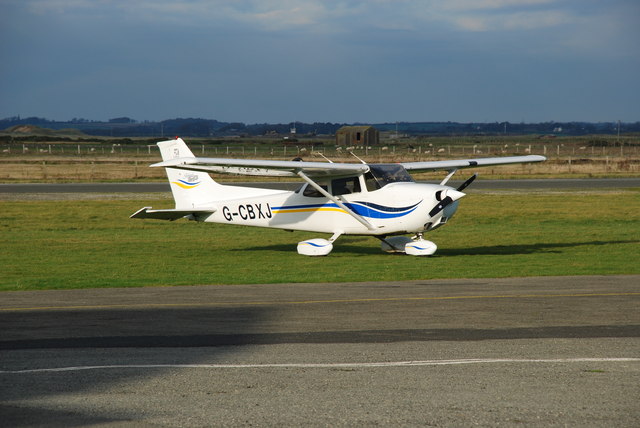
Synopsis
On 25 November 2019, a Cessna 172S aircraft, registration G-CBXJ, crashed into the sea near Puffin Island, Anglesey, during a private flight. The sole occupant, the pilot, sustained fatal injuries. The aircraft was destroyed. The investigation could not identify a definitive cause for the accident. No evidence of structural failure was found, and a trial simulating the final flight profile discounted a full or partial engine failure. The trial indicated that the aircraft likely required control input to enter and maintain the recorded descent path. The pilot had recently been unwell, but no evidence of medical incapacitation was identified, although it could not be ruled out.
History of the Flight
The pilot arrived at Caernarfon Airport at approximately 0915 hrs and had booked to fly G-CBXJ. The engine failed to start due to a failed starter motor shear pin. An engineer repaired the shear pin, and the pilot departed from Runway 07 at 1115 hrs. After takeoff, the pilot contacted Caernarfon Radio and then RAF Valley ATC at 1126 hrs, requesting a Basic Service for a short trip to Great Orme and back. The aircraft flew up the Menai Straits at about 1,400 ft, passed Bangor at 1130 hrs, then climbed to 1,500 ft and turned left towards Great Orme, before turning left again towards Puffin Island. At about 1205 hrs, flying club personnel checked the Flightradar24 app and found the aircraft had disappeared from the feed near Puffin Island. After unsuccessful attempts to contact the pilot, RAF Valley initiated overdue action. A search found debris floating north-west of Puffin Island later that afternoon.
Accident Site and Wreckage
Floating debris included the right wing, part of the nose landing gear, a first aid kit, and personal effects, located approximately 3 miles north-west of Puffin Island. The right wing had a crumpled leading edge. Seabed sonar surveys located the main wreckage about 1 mile off the north-east tip of Puffin Island in approximately 27 m of water. Video from a Remotely Operated Vehicle confirmed the wreckage as G-CBXJ. The aircraft was largely intact except for the detached right wing and engine. The left wing showed leading edge and lower surface crumpling consistent with high-speed impact. The aileron and elevators remained attached. The passenger compartment was severely disrupted, and the engine lay detached next to the main wreckage.
Recorded Information
The aircraft was equipped with an ADS-B Out transponder, broadcasting data at approximately 0.5-second intervals. ADS-B data showed the aircraft’s altitude, groundspeed, and heading. The last recorded position indicated a height of 5 ft over the sea, adjusted for QNH. During the final descent from 1,500 ft, the aircraft descended at rates reaching 1,700 ft/min, with true airspeed increasing to about 140 kt. The aircraft turned slightly right through about 20° as it descended through 600 ft, onto a heading of approximately 245°M.
Aircraft Information
G-CBXJ was a Cessna 172S high-wing, four-seat light aircraft with a fixed tricycle landing gear and a two-bladed fixed-pitch propeller, powered by a Lycoming IO-360-L2A piston engine. It was manufactured in 1999. The aircraft had been maintained per the manufacturer’s service plan and had undergone a 50-hour interval inspection and an annual inspection in March 2019. At the time of the accident, it had accumulated 6,072 flying hours. The aircraft was fitted with a manual pitch trim system and a single-axis autopilot, which was unserviceable with the circuit breaker pulled and placarded. No other known defects were reported.
Pilot Information
The pilot, aged 79, held a Private Pilot’s Licence since 1977 and an instrument rating since 1983, renewed in August 2019. His total flying experience was more than 2,200 hours, with 4 hours in the last 90 days and 1 hour in the last 28 days. He had flown the accident route many times before.
Medical Information
The pilot held a valid EASA Class 2 medical certificate with a limitation for defective near and distant vision. He had a history of migraine but had not experienced an attack for over ten years. Medical opinion considered it unlikely that migraine or Transient Global Amnesia caused incapacitation during the flight. In the week before the accident, the pilot had been unwell with a cough and cold, for which he self-medicated and spent 48 hours in bed. He had recovered enough to attend a rugby match two days before the accident. During a car journey to the match, the pilot, as a passenger, reported feeling ‘strange’ when the car accelerated suddenly.
Investigation
The AAIB conducted a field investigation. The probable cause was not determined. No definitive cause was found.