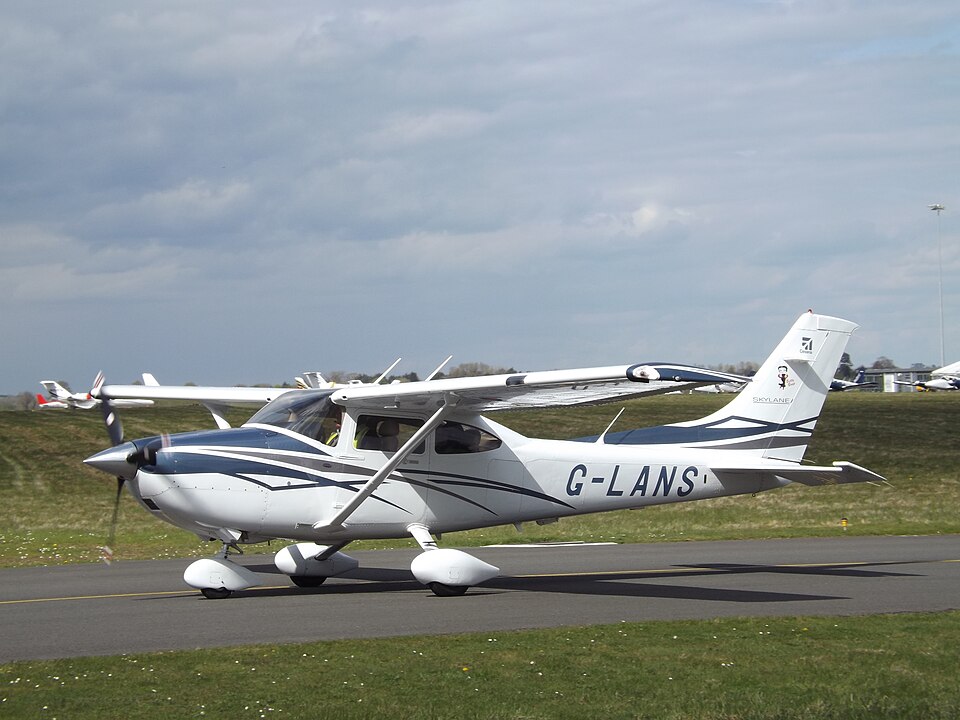
Accident
On 9 December 2017 at 1215 UTC, a Cessna 182T Skylane, registration G-LANS, overran the prepared surface of Runway 13 at Bodmin Airfield, Cornwall, and overturned onto a private road. The pilot and two passengers escaped without injury by opening the doors. The aircraft was damaged beyond economic repair.
Aircraft and Pilot Information
The aircraft was a 2007 Cessna 182T Skylane, powered by one Lycoming IO-540-AB1A5 piston engine. The pilot, aged 61, held a Private Pilot’s Licence issued in July 2015, with 197 hours total flying experience (52 hours on type). His Single Engine Piston (SEP) rating had expired in July 2017, though he remained current. The pilot had no injuries.
Flight History
The flight originated from Oxford Airfield. The pilot obtained information indicating Runway 31 would be in use at Bodmin, with a wet grass surface. The Landing Distance Available (LDA) for Runway 31 was 540 m. The pilot had visited Bodmin twice before, including three takeoffs and three landings on Runway 13 with an instructor less than four months prior. Upon arrival, he learned Runway 13 was in use (surface wind 140° at 5 kt). Although aware of a downhill gradient on Runway 13, he believed the LDA of 598 m was sufficient for a short field landing, despite the aircraft being close to maximum landing weight.
While joining the circuit, the pilot orbited to make way for traffic and unintentionally climbed. He was higher than intended throughout the circuit and on final approach, with an indicated airspeed of 75 kt, faster than ideal. He selected two stages of flap, omitting the final stage required for a short field landing. He realized he would touchdown further along the runway than planned but believed stopping distance remained adequate. After touchdown, the pilot initially applied normal braking due to the wet grass. When he recognized the short remaining distance, he applied maximum braking but felt the wheels skid before the aircraft exited the runway at low speed. The aircraft overran down a grass bank and overturned.
Performance Considerations
The Pilot’s Operating Handbook (POH) specifies for a short field landing an approach speed of 60 kt with full flap and maximum braking. The pilot’s pre-flight calculations used only the ground roll distance (183 m) from the POH, applying CAA factors for wet grass (35%) and a general safety factor (43%), resulting in a required landing distance of 353 m. He did not account for crossing the threshold at 50 ft as per the POH, which would have required 416 m, plus 10% for downhill slope and 35% for wet grass, totaling 618 m—exceeding the LDA of 598 m. Additionally, the actual approach speed of 75 kt and use of intermediate flap further increased the required distance.
Aftermath
The airfield operator reported the grass was cut the previous month, and although wet, was not soft or slippery. Later that day, other aircraft landed uneventfully on the same runway. Following the incident, the pilot completed refresher training and passed a proficiency check to renew his SEP rating. He noted he had not realized his rating had expired due to an administrative oversight.
Probable Cause
No probable cause was stated in the report.