Incident Details
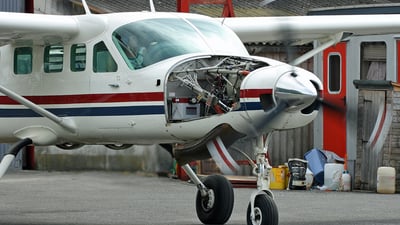
On 21 February 2018 at 1630 hours UTC, a Cessna 208B Grand Caravan (registration G-BZAH, serial no. 208B0811) sustained a nose landing gear drag link spring failure during the landing roll at Netheravon Airfield, Wiltshire. The flight was a private operation with a single crew member (the commander, aged 36, holding a Commercial Pilots Licence with 3,000 total flying hours, including 2,100 hours on type; last 90 days: 150 hours; last 28 days: 40 hours). No passengers were on board. The commander reported that following a normal landing, he heard a loud bang and noticed the aircraft nose appeared lower than normal. He stopped the aircraft and shut down the engine to carry out an inspection, which identified that the nose landing gear drag link spring had failed.
Investigation Findings
A detailed analysis of the failed part, carried out on behalf of the operator, indicated that the failure was most likely due to damage to the protective coating on the high-strength steel spring. This damage had allowed moisture exposure, initiating a corrosion fatigue mechanism that led to a crack and eventual failure. The damage was confined to the nose gear drag link spring; no other damage was reported. The commander and aircraft were uninjured. The failure is being addressed through normal continued airworthiness processes.