History of the Flight
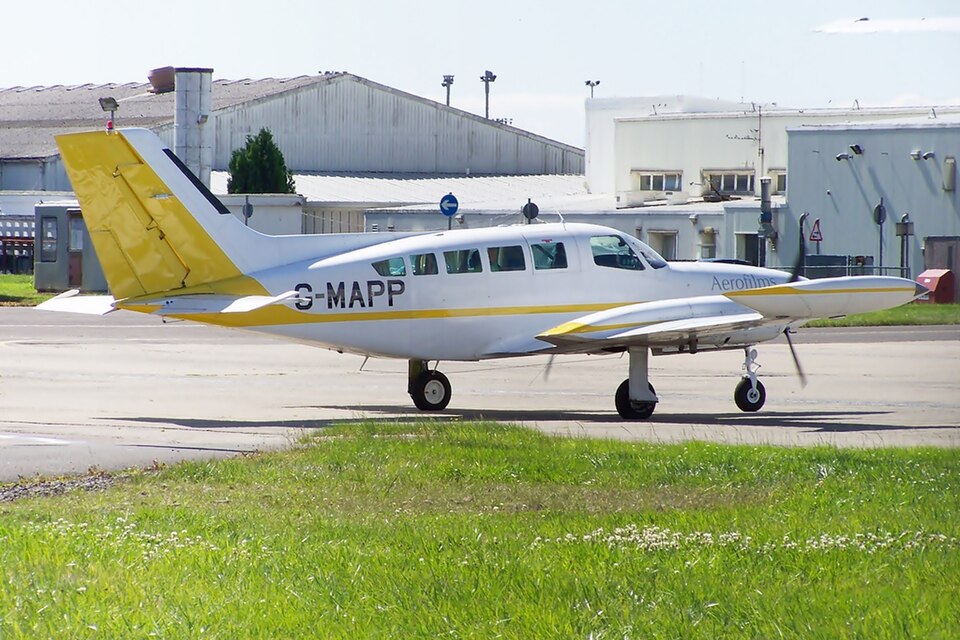
On 14 January 2016, G-MAPP, a Cessna 402B, departed from Runway 27 at East Midlands Airport at 1141 hrs for a training flight. On board were an instructor and two pilots recently joined to the operator, one occupying the left pilot seat and the other observing from the cabin. The instructor was in the right pilot seat. Weather conditions were good with a crosswind component of 11 kt, within the company limit of 16 kt.
The aircraft conducted two approaches to overshoot and two touch-and-go landings before a fifth approach, during which the instructor planned to demonstrate a flapless approach to a full stop landing. The approach was uneventful, with the landing gear confirmed as down by all on board, and the landing was described as smooth. After touchdown, as the aircraft slowed, the left wing began to sink and the left propeller contacted the ground. The instructor made a MAYDAY call but could not keep the aircraft on the runway; it came to rest on grass south of the runway, west of Intersection S. The three occupants, uninjured, evacuated the aircraft. Fire crews arrived quickly but there was no fire.
Aircraft Information
The Cessna 402B is a twin-engine aircraft with a retractable tricycle landing gear. The estimated landing weight at the time was approximately 5,700 lb, within the maximum certificated landing weight of 6,300 lb, and the centre of gravity was within limits. The landing gear retraction system uses an electric motor driving rods, torque-tubes, and bellcranks. The main landing gear is held in the down-and-locked position by a folding side brace, with a downlock link applying force to keep the side brace over-centre. A microswitch on the downlock link illuminates a green indicator light when over-centre. The downlock pin is secured by a set screw, and an arrow on the pin must align with the set screw for correct installation.
Damage and Examination
The left wingtip, left aileron, and left propeller blade tips were heavily abraded; the left landing lamp was torn out. The left main landing gear collapsed: the head of the bellcrank pivot bolt was missing, the forward mounting lug was fractured, and the downlock pin and bushes were missing. Metallurgical analysis showed no pre-existing cracks; all fractures were due to overload. The pivot bolt hardness was within the specified range.
Examination of the left downlock link revealed that the end fitting had rotated approximately 45 degrees clockwise. The set screw head protruded 4 mm (about five threads) above the casting, and its end was flush with the bore wall, not entering the hole in the bush. The bush had circumferential damage 4 to 5 mm from the forward face. In contrast, the right downlock link had the same set screw protrusion but the pin would have been locked; the left pin would have been free to move. The operator's Cessna 310R aircraft showed a typical clearance of about 2 mm.
Maintenance and Investigation
The aircraft had undergone annual maintenance in May 2015, which included removal of the left main landing gear leg for non-destructive inspections and replacement of the pivot pin. The set screw and downlock pin were not disturbed during that maintenance. Rigging and functional checks were performed per the manual. The accident occurred 90 cycles and 117 flying hours after that maintenance. A 50-hour inspection on 22 December 2015 included a visual check of the main landing gear with no reported faults. The downlock pin's last disturbance could not be established.
The Cessna 401/402 Service Manual chapter for set screw installation does not specify a minimum insertion depth. A 1976 Service Letter instructed an inspection within 200 hours, but no repeat inspection criteria were established, and the letter's instructions (e.g., staking) were outdated for G-MAPP, which used wire locking. The manufacturer’s instructions lacked details to ensure the set screw adequately secures the pin.