Summary
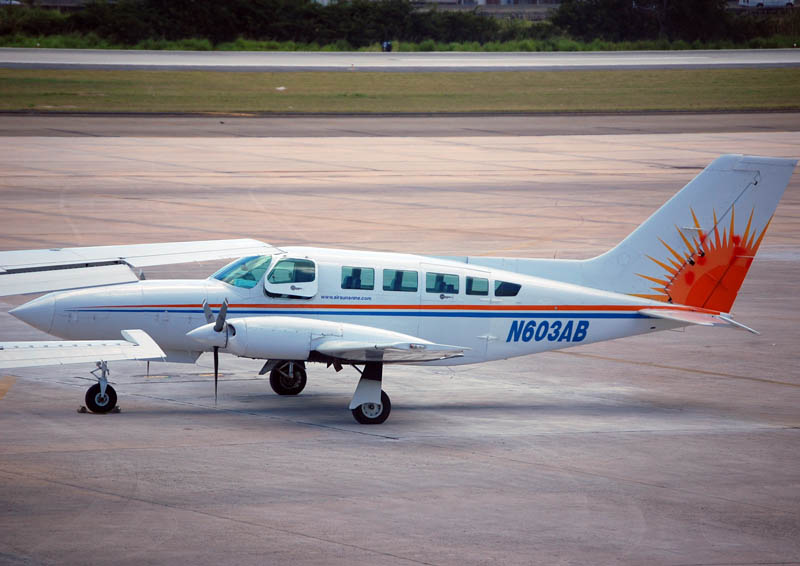
On 11 February 2017 at 2004 UTC, Cessna 402C N603AB departed the paved surface after landing on Runway 03 at Virgin Gorda Airport, British Virgin Islands. The aircraft came to rest on a bank at the edge of the ramp. None of the nine occupants (one pilot, eight passengers) were injured. The aircraft sustained extensive damage to the landing gear and structure.
History of the Flight
The aircraft was on a commercial passenger flight from St Thomas, US Virgin Islands to Virgin Gorda. The pilot had flown eleven flights that day, four to Virgin Gorda. The flight from St Thomas took 35 minutes. Weather was excellent with a light easterly wind. The pilot performed a normal touchdown and retracted the flaps before applying brakes. The right brake felt less positive than expected. On reapplication, the left brake pedal “flopped to the floor”. The pilot judged he could not abort and continued pumping brakes, shut down engines before leaving the paved surface, struck signage and a low wall, and came to rest on a bank.
Aircraft Information
The Cessna 402C is a low-wing twin-engine aircraft with retractable tricycle landing gear. N603AB (serial 402C0603) had accrued about 20,200 flying hours. It was equipped with an Aircraft Payload Extender/Short Takeoff and Landing (APE STOL) modification. The operator had completed an extensive maintenance programme over three years; the aircraft had 41 hours and 95 cycles since return to service in January 2017.
The aircraft had a previous accident at Virgin Gorda in March 2008. The official narrative stated that the left brake failed during landing, and the aircraft struck a terminal building and other objects.
Examination
After the accident, tyre marks indicated heavy sideward loading. No evidence of locked brakes. The nose landing gear collapsed, right main landing gear broke off. The left propeller was not rotating (engine shut down); right propeller had low energy rotation.
Post-recovery testing: Left brake functioned normally. Right brake could not be tested due to detached landing gear and broken hydraulic pipes. Brake master cylinders were removed for further examination.
Findings
Left master cylinder: Missing filler plug; loose cover plate; missing rubber ring; debris and aluminium flakes in reservoir; broken return spring pieces found in housing bore; the piston rod spring guide secured by a roll pin (contrary to Cleveland design but conforming to Gerdes Product Co). Right master cylinder: Missing filler plug; tooth-lock washer fitted to secure loose bushing; debris and general dirt; stat-o-seal degradation. Maintenance records for master cylinders were not available. The Cessna maintenance schedule requires visual inspection and functional test every 200 hours/12 months, with no scheduled requirement to change brake fluid or overhaul components.