History of the Flight
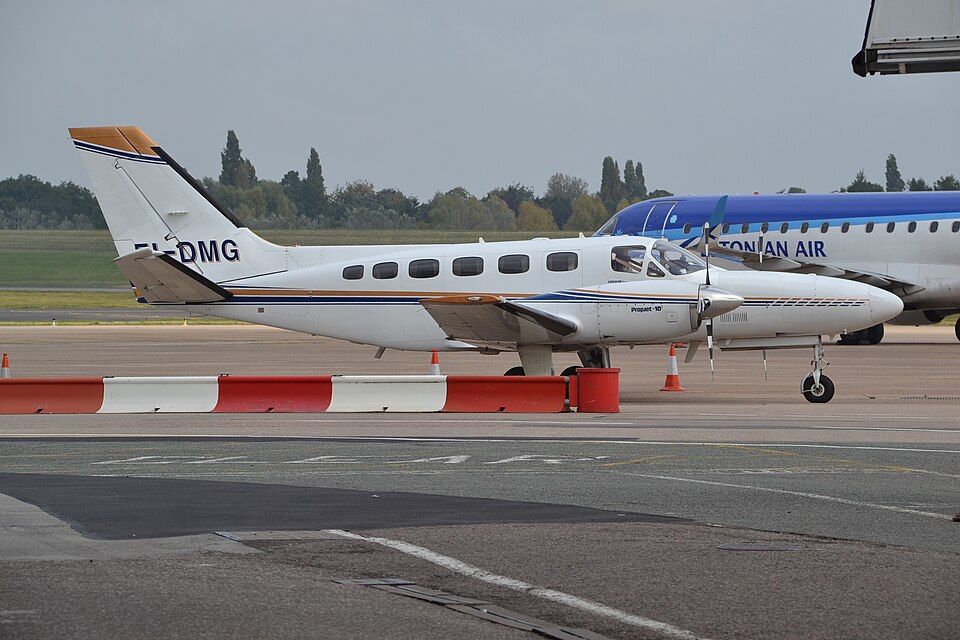
The company-owned Cessna 441 Conquest II, registration EI-DMG, was operating a private flight from Waterford Airport, Ireland, to Glasgow Prestwick Airport, UK, on 25 June 2019. Although certified for single-pilot operations, the company always operated with two pilots. The commander flew from the left seat while the company’s senior pilot occupied the right seat.
The ILS approach to Runway 30 was uneventful. The before-landing checks were completed, and the commander recalled that all three green landing gear down-and-locked lights illuminated. Full flap was selected. After a smooth touchdown on the main landing gear, as the nose began to lower, both pilots noticed it continued dropping beyond normal. A scrubbing or scratching sound was heard. They briefly considered a go-around but deemed it unfeasible due to possible damage. They increased engine power and applied back pressure to keep the nose off the ground while activating the landing gear emergency blow-down system. Upon reducing power and relaxing back pressure, the nose landing gear extended, and the landing roll continued uneventfully.
While taxiing to parking, a passenger alerted the commander to fuel leaking from the right engine. The taxi was expedited, and firewall shutoff valves were activated. No injuries occurred; occupants disembarked normally. The aircraft sustained damage to the engines and propellers. Runway inspection revealed propeller strike marks over several meters in the touchdown zone.
The commander reported no anomalies with the nose landing gear during pre-flight inspection or after takeoff from Waterford. The landing gear warning horn did not sound during the approach. A photograph taken prior to touchdown shows the nose landing gear partially extended.
Landing Gear System Description
The Cessna 441 has a retractable tricycle landing gear, electrically controlled and hydraulically actuated. Normal extension and retraction use hydraulic actuators for each gear. During extension, hydraulic pressure releases uplock hooks and extends the actuators. An internal spring-loaded mechanical lock engages when fully extended. An electrical downlock switch on each actuator indicates when the piston is locked. Once downlock mechanisms engage, a hydraulic bypass valve opens, returning fluid to the reservoir.
The emergency blow-down system uses pressurized nitrogen to release uplock hooks and drive the gear down and locked. The landing gear indication and warning system includes three green down-and-locked lights (one per gear), a red in-transit light, and an audible warning horn that sounds under specific conditions (power levers at flight idle with gear not down and locked, or flaps extended beyond approach with gear not down). The nose landing gear downlock switch is a two-pole switch: one pole grounds the nose gear down light, the other grounds the warning horn.
Examination and Manufacturer Information
At the time of publication, only a preliminary examination of the nose landing gear had been conducted; further detailed examination was scheduled. Neither the cause of the failure to deploy nor the failure of the indication system had been determined, but the maintenance agency suspected a faulty downlock switch on the nose landing gear actuator.
The aircraft manufacturer identified several possible conditions that could cause the nose gear down-and-locked light to illuminate despite the gear not being fully extended. A faulty downlock switch could provide a continual ground to the light, regardless of actual position. Other potential sources include an electrical short in the wiring from the light to the switch, inadvertent grounding on terminal board 1, incorrect wiring, or a defect in the annunciator logic module.
The manufacturer also indicated that a faulty downlock switch could explain the failure to fully extend: if the switch failed in the down-and-locked position, selecting gear down would immediately ground the down light and the hydraulic bypass valve, causing the valve to open and remove hydraulic pressure prematurely. The main landing gear, assisted by airflow, would extend, but the nose gear, extending against airflow, might not complete extension. This failure would also remove the ground path for the warning horn, preventing its operation.
Cessna service documents (SNL89-3 and CBQ90-1) note that downlock switches can be susceptible to moisture or contamination, potentially causing malfunctions and incorrect indications. EI-DMG was among serial numbers requiring inspection and sealing of these switches.
Discussion
The commander reported all three green down-and-locked lights illuminated during approach, with no warning horn or in-transit light. No anomalies were noted before or during the flight. The pilots were unaware of the unsafe nose gear until touchdown. The senior pilot assisted promptly, and both pilots acted to keep the nose off the runway and activate the emergency blow-down system, leading to a successful outcome with minimal damage.