Accident Overview
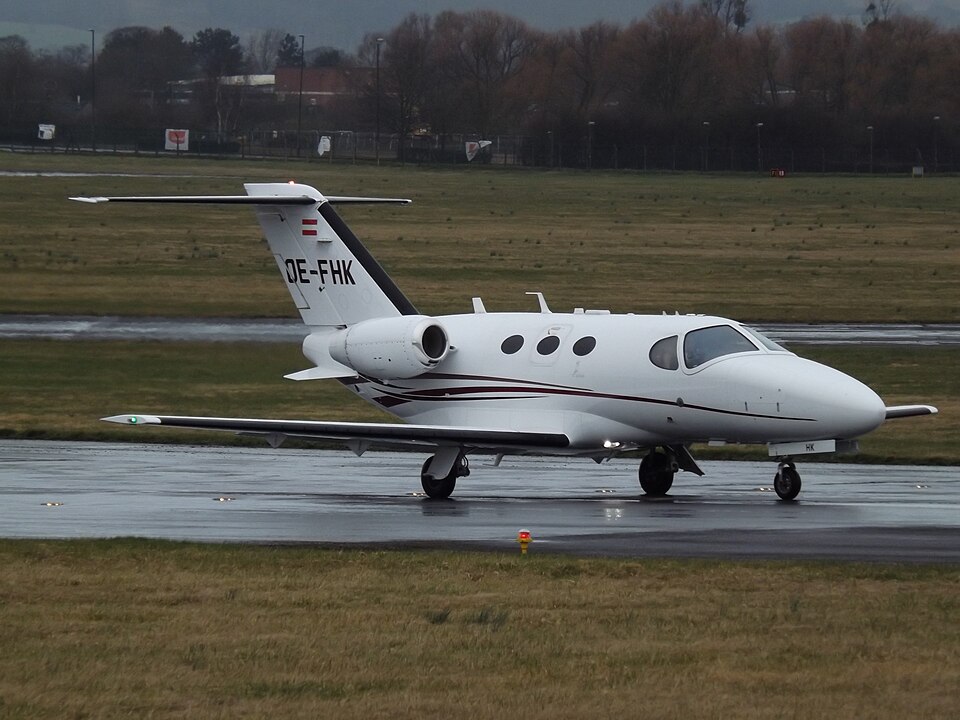
On 15 June 2017 at 1128 UTC, a Cessna 510 Citation Mustang (registration OE-FHK, serial no. 510-0315) collided with a fuel bowser at London Biggin Hill Airport. The aircraft was conducting a local training flight with two crew members and no passengers. Neither crew member was injured. The leading edge of the left wing and forward fuselage were dented, and the cabin access door hinge was distorted.
Background
The aircraft had been parked and shut down after its previous flight, then towed to a second and subsequently a third parking position. The wheels were chocked with the parking brake off when the flight crew arrived. The purpose of the flight was for the commander, a Type Rating Examiner, to complete the co-pilot's type rating training. The co-pilot had previously completed all type rating training using a flight simulator.
After refueling, the fuel bowser reversed away and stopped approximately two metres in front of the aircraft while the driver waited for other aircraft to move. The commander, noticing no ground personnel available, went outside to remove the wheel chocks. He stood to the left of the aircraft, which was parked on a slight slope, and signaled to the co-pilot to set the parking brake. The co-pilot pressed the brake pedals and pulled the parking brake handle, then indicated with a thumbs-up.
Sequence of Events
The commander removed the chocks and moved to place them clear of the aircraft. When he turned back, the aircraft was rolling toward the fuel bowser. He called to the co-pilot to apply the brakes, but the aircraft did not stop until it struck the bowser. The cabin door had been forced closed, trapping the uninjured co-pilot inside until the bowser moved away and the aircraft was secured.
Brake System Details
According to the aircraft operator's Pilot Training Manual, the normal brakes are powered by a hydraulic system pressurized by an electric pump, with an accumulator storing pressurized fluid. The manual stated that during pump inactivity, this pressurized fluid maintains pressure against normal internal leakage, but it gave no guidance on how long pressure would last or how many brake applications were possible without the pump running. The parking brakes are a locked configuration: pulling the parking brake handle while pressing the brake pedals mechanically actuates non-return valves to trap hydraulic pressure. An emergency brake system, controlled by a handle on the left side of the flight deck, uses pressurized nitrogen from a dedicated bottle.
The electric hydraulic pump turns on when the battery controller switch is set to the batt position. The co-pilot stated he had not been instructed to ensure this was done before applying the parking brake. The normal brake system functioned correctly when checked after the accident. The commander was surprised to learn that hydraulic pressure typically dissipates within 30 minutes of electric power being disconnected; he had expected pressure would be available without turning on the battery. The co-pilot did not realize that without electric power, only a limited number of brake applications were possible, and he was unaware of any checklist requirement for setting the parking brake.
Operator Procedures
The operator's Standard Operating Procedures included a 'Quick Turnaround' checklist (sixth item: battery switch to batt) and a 'Before Starting Engines' checklist (second item: battery on and voltage correct; fourth item: 'Wheel Chocks / Parking Brakes…Removed/On'). The normal procedure was for ground personnel to remove chocks during the 'Before Starting Engines' checklist. In exceptional circumstances with no ground personnel, it was acceptable for the flight crew to remove chocks, provided the checklist was still followed—though this was not documented in the Operations Manual.
Safety Actions Taken
Following the accident, the aircraft operator issued a Safety Bulletin reminding flight crew that the parking brake must only be set with the battery switch in the batt position, and that checklists must always be followed. The bulletin also warned against removing chocks if obstacles like a fuel bowser are nearby, and stated that trainee pilots must always be accompanied by an experienced crew member. The Standard Operating Procedures were modified to include additional guidance on parking brake operation and wheel chock use. Pilot training was revised to ensure comprehensive understanding of the hydraulic system and brakes.