Background
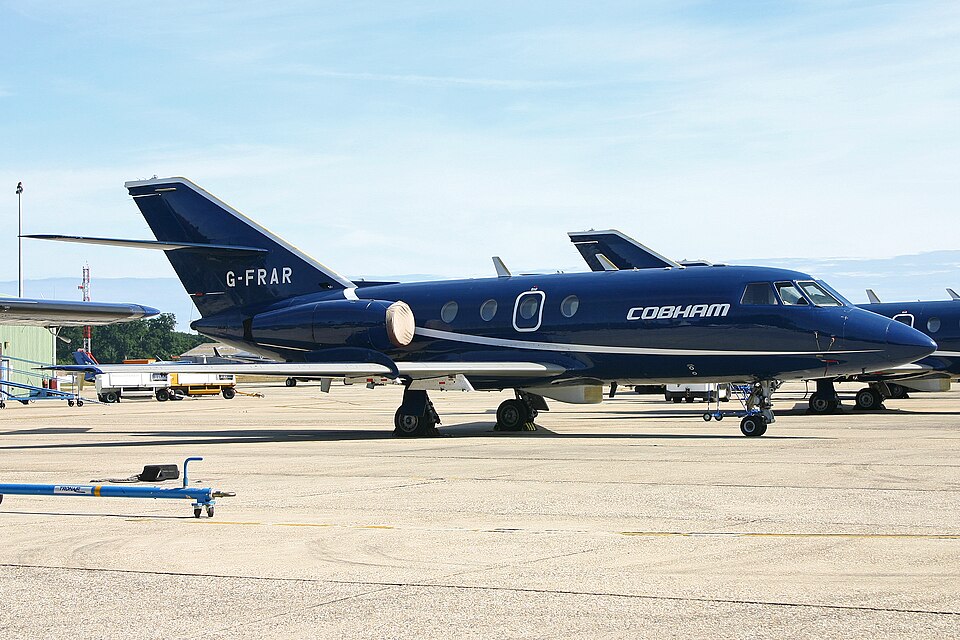
On 21 September 2015, a Dassault Falcon 20D (registration G-FRAR, serial no. 209) was conducting an aerial work mission involving target towing for a warship in a notified danger area over Lyme Bay, south of Dorset. The aircraft was manufactured in 1969 and powered by two General Electric Co CF700-2D-2 turbofan engines. The crew consisted of three persons, with no passengers on board. The commander, aged 51, held an Airline Transport Pilot’s Licence and had accumulated 8,737 flying hours, of which 4,423 were on type.
History of the Flight
The aircraft was flying at 1,700 ft amsl and 300 KIAS, trailing a target 23,000 ft behind and 40 ft above the sea surface. During a live-firing exercise, the crew observed the target sustain a hit, indicated by a yaw to the left—a normal occurrence. Immediately afterward, the aircraft lurched to the left, possibly due to the target striking the water. The crew detected instability in the target, prompting the Target Tow Operator (TTO) to cut the cable by activating the primary cable cutter switch on his control panel. The pilot flying felt a light vibration through the airframe and rudder pedals, while the TTO noted on his camera monitor that a length of cable remained and appeared to be “corkscrewing” behind the aircraft, likely striking the tailplane area. The pilot monitoring attempted to cut the cable using the secondary cable cutter switch in the cockpit, but this had no effect.
The crew declared an emergency and, after coordination with Air Traffic Control, decided to land on Runway 08 at Bournemouth, opting for an approach over the least populated area. The aircraft was configured to land with flaps up to minimize the risk of the cable fouling the wing control surfaces. Shortly after the landing gear was lowered, the cable ceased banging against the airframe. The TTO reported, “It’s hooked up on something…I think it’s the tail.” The aircraft landed without further incident.
Aircraft Information
The Falcon 20 is a business jet featuring a fin-mounted horizontal tailplane, aft-mounted engines, and swept wings. The elevator is a hydraulically-powered flying control. The aircraft was fitted with a target towing winch mounted on a pylon under the left wing at approximately mid-semi-span. Inside the winch outrigger is a cable cutter, which could be activated from either the cockpit or the TTO’s control panel. The target measured 2.9 m in length and weighed 53 kg. The TTO sat on the left side of the cabin ahead of the wing leading edge in a rear-facing seat, with access to a monitor displaying video from underwing cameras and a control panel.
Post-Flight Findings
After landing, the TTO discovered that one end of the approximately 10 m length of cable was lodged between the elevator and the horizontal tailplane, and a loop in the cable had snagged on the winch. The cable was removed from the gap between the elevator and horizontal tailplane without difficulty, and there was no evidence that the elevator’s operation had been restricted during the incident. Minor damage was noted on the upper surface of the horizontal tailplane.
Discussion
The damaged target likely struck the water after being hit, leading to complex motion with high variation in cable tension. The 10 m section of cable that remained attached had separated at both ends but became snagged on the winch due to a loop that formed after the target detached. A cut at the winch end was likely from activation of the cable cutter, while the break at the trailing end may have resulted from cable overload failure before the cutter was activated. Although the cable lodged between the elevator and horizontal tailplane, there was no evidence that it restricted elevator operation. The operator was considering a modification to introduce a ‘weak-link’ in the cable and a modification to the winch to reduce the likelihood of snagging.