Introduction
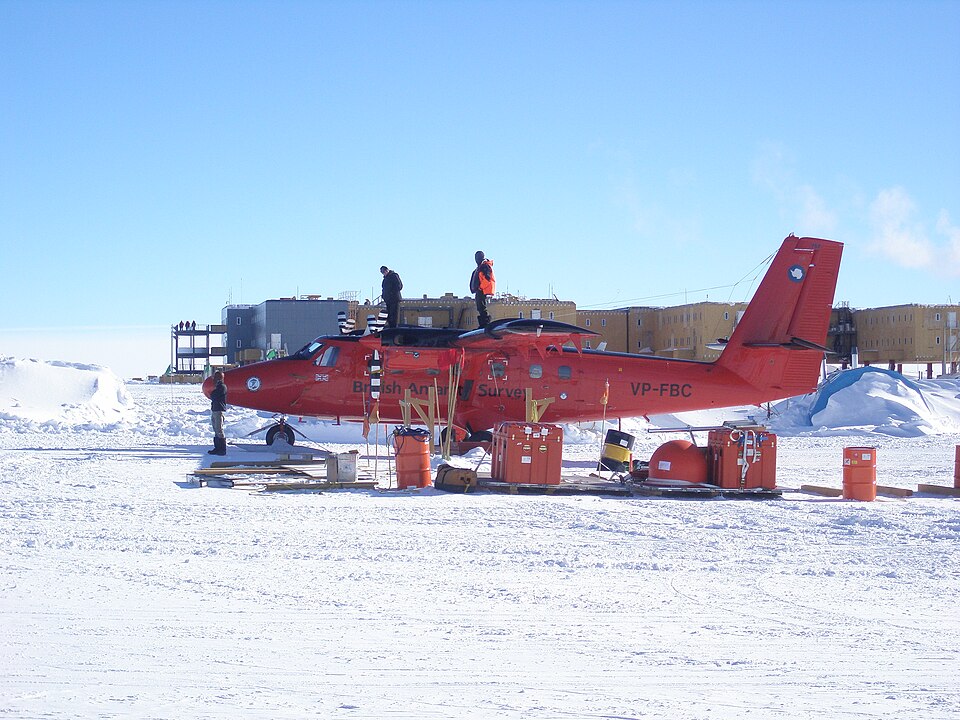
On 23 January 2023, a De Havilland Canada DHC-6-300 Twin Otter (registration VP-FBC) was involved in an accident during departure from an unprepared landing site at Station E322, near Mount Lymburner at the north-west end of the Ellsworth Mountains, Antarctica. The aircraft was operated by a private company in support of polar research. The two-person crew—a commander and a field guide—were uninjured. The aircraft sustained damage to the fairing around the landing gear and the upper and lower forward bulkhead.
History of the Flight
The commander was tasked to transport a field team to Station E322. After assessing the weather as "good," he briefed the task and nominated a nearby unmanned fuel depot, Castle, as a diversion. Upon arrival, the commander evaluated the site and prepared a skiway aligned with the direction of ice ridges (sastrugi). The aircraft landed without incident.
During the departure, the commander elected to use the prepared skiway rather than the landing trail. Almost at rotation, he felt the right ski sink, pulling the nose to the right. Despite corrective action with differential power and rudder, a large impact was felt on the nose ski, after which the aircraft became airborne. The field guide later considered the impact unremarkable.
After takeoff, the commander noticed that the standby artificial indicator showed a 40° bank while the aircraft was level, and the attitude indication on the No. 1 primary flight display seemed slightly off. Additionally, the covers around the rudder pedals were dislodged. Considering diversion options, he determined that although he had enough fuel to return to Sky Blu field station, it would not meet mandatory minimum reserve. He opted to land at Castle, which had a known smooth surface, good weather, and fuel.
Damage and Inspection
After landing at Castle, the commander inspected the aircraft and found damage to the external nose gear, surrounding aircraft skin, nose baggage bay, and avionics and hydraulic bays. The forward bulkhead at station 60 appeared torn and buckled, but flying controls were undamaged with no restrictions. He assessed that no major structures were compromised and the aircraft was safe to fly. He refueled and flew to Sky Blu without further incident.
Upon landing at Sky Blu, a licensed engineer confirmed damage to the upper and lower forward bulkhead at station 60. The type certificate holder issued a Repair Engineering Order for a temporary repair, allowing a ferry flight with a maximum of two cycles and eight flying hours.
Aircraft and Site Information
The DHC-6-300 Twin Otter is a high-wing, fixed landing gear utility aircraft modified with wheel-ski gear for Antarctic operations. The forward bulkhead at station 60, connecting the nose landing gear to the flight compartment, is known to be susceptible to damage from nosewheel impacts.
Station E322 is an unprepared site on an ice shelf with compacted snow and small sastrugi. The commander described the landing run as similar to a rough grass airfield. The diversion airfield, Castle, is located about 40 nm away and has a prepared skiway but is unmanned and subject to extreme conditions.
Meteorological and Communication Details
Weather forecasting relied on satellite and model data without ground observations. At the time of the accident, visibility was unlimited with few high-level clouds and good contrast; the sun was just above the horizon and winds were calm. Communications between aircraft and base were primarily via HF radios, with satellite phones as backup.
Personnel
The commander held a Commercial Pilot’s Licence, had 5,438 hours total flying experience (3,223 hours on type), and was working towards a Part 66 engineering license. The operator considered him to have considerable polar flying experience combined with strong technical knowledge.