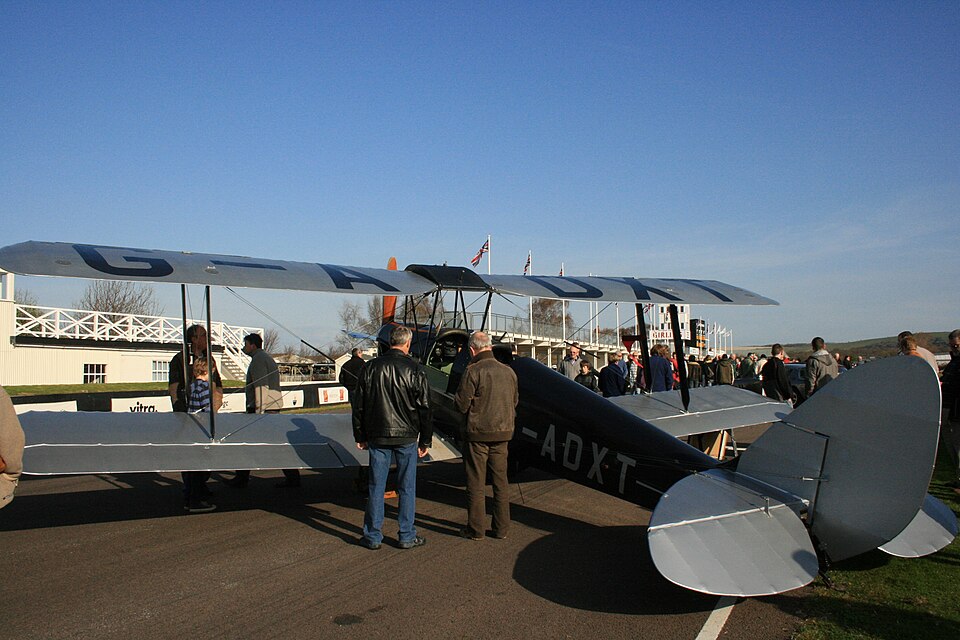
Synopsis
On 26 August 2017, a De Havilland DH82A Tiger Moth, registration G-ADXT, was conducting an introductory flight from Compton Abbas Airfield in Dorset. Shortly after becoming airborne, the engine was heard to misfire. The pilot reported an engine problem and intended to return. While on base leg for Runway 26, the aircraft pitched down and entered a steep descending turn, impacting a crop field. Both occupants sustained fatal injuries, and the aircraft was destroyed by impact and post-crash fire.
History of the Flight
The flight was the first of the day for G-ADXT, and the pilot performed a full pre-flight inspection, including checking the fuel tank quantity (full) and a water check of a fuel sample. The passenger arrived and received a briefing and safety equipment, then was assisted into the front cockpit. The pilot occupied the rear cockpit. The flight was planned for 30 minutes.
During engine start, the propeller was hand-swung. On the second swing, the engine ran backwards. Following the manual, the propeller was turned backwards several rotations, and subsequent start attempts were made. On the third cycle, the engine started and warmed up normally, with magneto checks sounding satisfactory.
The aircraft taxied to Runway 08 and began takeoff. It became airborne at about the 300 m marker, at which point the engine was heard to misfire. The aircraft continued climbing and made a left turn to the north. The pilot transmitted in a calm voice that he had a rough-running engine and was making a 180° turn to land on Runway 26. The radio operator reported light northerly wind. Witnesses observed the aircraft from various positions; some described a slow, unstable appearance, a wing drop, and a rapid descending turn. One witness saw it make a gentle descending left turn onto a right base leg, then pitch sharply down and roll left into a steep descending turn before impact.
The accident was reported at 0828 hrs. The aircraft struck the ground in a steep nose-down attitude, coming to rest on a heading of approximately 130°M.
Accident Site and Wreckage
The accident site was in a cornfield about 0.4 nm east of the threshold of Runway 26. Examination indicated the aircraft was structurally intact before impact. A significant post-crash fire consumed most of the fabric covering and cockpit structure, including seats and instruments. The steel fuselage frame was distorted. Wooden wing spars burned, with the right wing more severely damaged. Both safety harnesses were consumed, but their lugs were found fully engaged and locked. The front cockpit shoulder harness attachment cable had failed due to overload.
Both propeller blades broke mid-span; one was embedded in the soil, the other remained attached to the hub. The remains were found to the left of the aircraft centerline. Flying controls and their mechanisms were intact before the accident. Approximately two litres of residual fuel were siphoned from the ruptured fuel tank.
Aircraft Information
The DH82A Tiger Moth is a single-engine biplane with tandem open cockpits. G-ADXT was built in 1935 and powered by a De Havilland Gipsy Major 1H piston engine. It was fitted with leading-edge slots on the upper wings but not with optional anti-spin strakes. The fuel system had a gravity-fed tank of 19 Imperial gallons capacity. A mandatory airworthiness directive required a locking device for the fuel shut-off valve to prevent inadvertent closure in flight; the device was found serviceable among the wreckage. The aircraft was equipped with ‘Z’-type safety harnesses, with shoulder straps attached by a transverse cable.