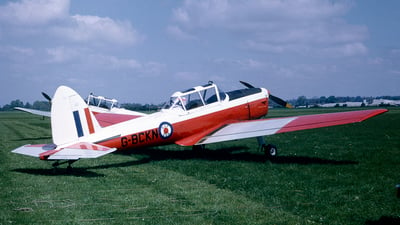
Accident Details
On 17 October 2020 at 1050 UTC, a private DHC-1 Chipmunk 22, registration G-BCKN, experienced a directional control issue during landing at Blackpool Airport, Lancashire. The aircraft was performing circuits and had initially taken off on Runway 28. Due to light and variable winds, air traffic control changed the active runway to Runway 10. The wind was reported from 040° at 7 kt.
The pilot reported no difficulty during the approach. Following a straight three-point touchdown at 50 kt, the aircraft swung to the left. Despite the application of full right rudder, the aircraft departed the runway onto the grass. It then struck a Precision Approach Path Indicator (PAPI) light on the left side of the runway, resulting in minor damage to the right wing surface and flap.
The pilot did not use differential braking during the landing roll, as he assessed the wind to be calm to very light. He could not account for why the aircraft unexpectedly swung left. He stated he considered a go-around but chose to commit to controlling the ground roll from the runway onto the grass to avoid a propeller strike on the soft ground. There were no injuries to the sole crew member or the one passenger.
Aircraft Examination
An engineering inspection commissioned by the aircraft owner reported that the main wheel braking system and tail wheel were free from defects and all system perishables were found to be in good condition.
Brake System Description
The Chipmunk is equipped with a hand-operated wheel brake system. A lever on the left sidewall of the cockpit is pulled rearwards to apply the brakes. For ground manoeuvring, differential braking is available by action on the rudder pedals. If the wheel brake lever is in the fully forward position, no braking is applied to either main wheel, even if full pedal is applied in one direction. As the lever is pulled rearward, progressively more brake pressure is applied to the wheel corresponding to the rudder pedal held forward. A finger-operated collar at the base of the handgrip can hold the lever in a given position. Both brakes are inoperative when the rudder pedals are centralised. The various lever positions are defined by a ratchet device. A combination of lever movement and rudder pedal displacement modulates differential braking force for directional control on the ground. If differential braking is required for a crosswind landing, the correct amount of brake can be set in the air.
Discussion on Brake Use in Crosswinds
Advice on the use of brakes in the Chipmunk community is varied and divided. The debate centres on whether to pre-set the system for differential braking to be immediately available on landing, versus relying primarily on rudder authority for directional control followed by gentle use of the brake lever. The Pilot’s Manual refers to differential braking for crosswind landings and taxiing but offers no further advice. The pilot commented that he would seek further advice from a qualified Chipmunk instructor on suitable techniques for controlling the landing roll in various wind conditions.