History of the Flight
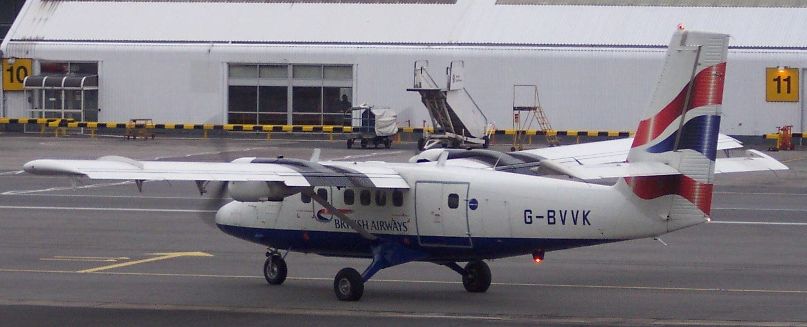
The aircraft, a DHC-6 Series 310 Twin Otter (G-BVVK), departed Glasgow at 1635 hrs on a scheduled passenger flight to Tiree with two crew and seven passengers. The weather forecast indicated strong southerly winds, a cloudbase of about 500 ft, and visibility between 2,000 and 4,000 m. The crew briefed for and executed a VOR/DME approach to Runway 23, as Runway 17— though more into the prevailing wind—had no direct instrument approach and the cloudbase was below circling minima. The co-pilot was the pilot flying for the approach, with the commander taking control for landing when visual with the runway.
On first contact with the Tiree AFISO, the crew were advised the surface wind was from 160° at 24 kt, gusting to 35 kt. Approximately five minutes before touchdown, the wind was reported as 160°/27 kt. Two minutes before touchdown, the wind was 170°/25 kt, and just before landing it was 170°/23 kt; these later checks did not include gust information.
The approach was uneventful, and the commander took control when the runway became visual at about 450 ft amsl (MDA 410 ft). The crew described the landing as normal, with control inputs consistent with the crosswind. After touchdown, the left wing suddenly lifted as the aircraft decelerated, and it veered left. Despite full right rudder and left aileron, the aircraft continued left for two to three seconds before resuming a normal attitude. The aircraft was then stopped using normal braking. The crew believed a sudden strong gust had occurred.
Airport crash alarms were sounded, and the RFFS responded but were quickly stood down. The crew initially thought they had remained on the asphalt at the side of the runway, but inspection after shutdown revealed the aircraft had departed the paved area and crossed grass. The aircraft was taken out of service until an engineering inspection confirmed no damage.
Meteorological Conditions
Meteorological records from Tiree Airport around the time of the incident (landing approximately 1745 hrs) showed regular gusts up to approximately 30 kt. The table of recorded wind data indicates mean wind speeds from 21 to 28 kt and maximum gusts from 25 to 32 kt. However, the wind figures passed by radio to the aircraft were taken from the Runway 23 touchdown zone indicator, whose output was not recorded, and may have differed from the recorded values. According to CAP 746, gusts are reported only if they exceed the mean speed by 10 kt or more.
Aircraft Performance
The manufacturer's Pilot Operating Handbook and Aircraft Flight Manual state that adequate controllability during landing has been demonstrated using full flap extension in crosswind components up to 25 KIAS, but this is not considered limiting. The operator's policy is to consider 25 kt, including gusts, as a limit.
Analysis and Conclusion
The crew were aware of a strong southerly wind from the forecast and from AFISO reports, including the possibility of gusts to 35 kt. During the approach, they requested two additional wind checks, indicating the wind was within their 25 kt crosswind limit, so the commander decided to land. The crew considered the aircraft response normal for a crosswind of around 25 kt.
However, meteorological records showed surface wind gusting to approximately 32 kt. During the rollout, as the aircraft decelerated, it appeared to weathercock as the flight controls lost authority. Given the information they received, the crew believed the wind was within limitations, but it is highly likely that the aircraft was affected by a strong gust of wind from the left during the landing roll, which suddenly overcame the controls—reduced in effectiveness due to low airspeed. Consequently, the aircraft veered sharply left and departed the paved surface. There were no injuries and no damage to the aircraft or airfield infrastructure.