Incident Overview
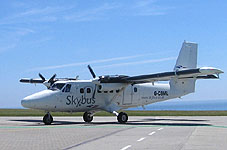
On 13 March 2023, a DHC-6 Series 310 (Twin Otter) registered G-CBML was involved in a serious incident during landing at St Mary's Airport, Isles of Scilly. The aircraft, operated by a commercial air transport company, was on a scheduled passenger flight from Land's End Airport. The two crew members and 15 passengers were uninjured, and the aircraft sustained no damage.
History of the Flight
Earlier flights had been cancelled due to strong winds at St Mary's. By early afternoon, the wind had reduced slightly, with the 1450 UTC METAR indicating a surface wind from 220° at 22 kt, within aircraft limits. The commander decided to proceed. The aircraft departed Land's End at 1510 UTC.
The commander conducted a visual approach to Runway 27, landing with full flap. ATC reported the surface wind as "210° at 19 kt, maximum 27 kt" and later gave an instant check of "210° at 20 kt". Touchdown occurred at 1534 UTC.
The initial touchdown was smooth but slightly further down the runway than ideal due to floating. After all three wheels were on the ground, the right wing began to lift. The commander reduced in-to-wind aileron to lower the right wing, but the left wing then rose violently and the aircraft veered left, weathercocking into wind on only the nose and right main wheels. Unable to lower the left wing or stop the drift, he applied full power and called for a go-around. The co-pilot selected Flap 10.
The co-pilot recalled a stable approach and normal initial touchdown, followed by a wheelbarrow-like motion on two wheels with a left pull and a sense of the right wing lifting. The ailerons were near neutral. As the aircraft left the runway, the commander initiated the go-around. The aircraft traveled approximately 12 m across adjacent grass before becoming airborne, accelerating in ground effect as flaps retracted, then climbing away. After a brief discussion, the crew made a second uneventful approach and landed at 1539 UTC.
Inspection revealed no damage, but tyre marks were found leaving the runway just past the intersection and extending 12 m onto the grass. Two local pilots reported two significant gusts punctuated by a short lull during the landing.
Aerodrome and Weather
St Mary's Airport has runways 14/32 and 09/27. Runway 27 is 522 m long by 18 m wide with a declared LDA of 501 m. The AIP warns of extreme caution due to a hump-backed runway with gradients up to 1 in 13, and turbulence/windshear may affect the final half mile of approaches.
The 1520 UTC METAR reported surface wind from 220° at 22 kt, visibility 8 km, few clouds at 1,400 ft, temperature 12°C, dewpoint 9°C, QNH 987 hPa. Runway conditions were wet/wet/wet (code 5/5/5).
Flight Crew
The commander held a Commercial Pilot's Licence, aged 63, with 9,700 hours total (5,000 on type), including 67 hours in the last 90 days and 21 in the last 28 days. He was a training captain with Class Rating Instructor and Examiner ratings. The co-pilot had 1,300 hours total, 1,000 on type.
Organizational Information
The operator had identified runway excursion risk at St Mary's due to narrow, short runway and implemented mitigations: specific weather limits for less experienced pilots, base training checks before operating at St Mary's, ATC reporting mean and max wind, stabilized approach requirements, reduced crosswind limits at night, and mandatory prior circuit training. These had been effective before this incident. After this event, the operator plans to display a live wind plot in the Land's End crew room and a live webcam from St Mary's. The chief pilot is also considering reducing the 12 kt headwind requirement for Flap 20 use at lower weights, though it would not have helped this approach as the aircraft was near maximum landing weight.
Conclusion
The commander's quick decision to go around prevented a more serious outcome. The combination of gusting wind and the amount of in-to-wind aileron applied caused the aircraft to roll right and weathercock into wind, resulting in a left veer off the paved surface.