History of the Flight
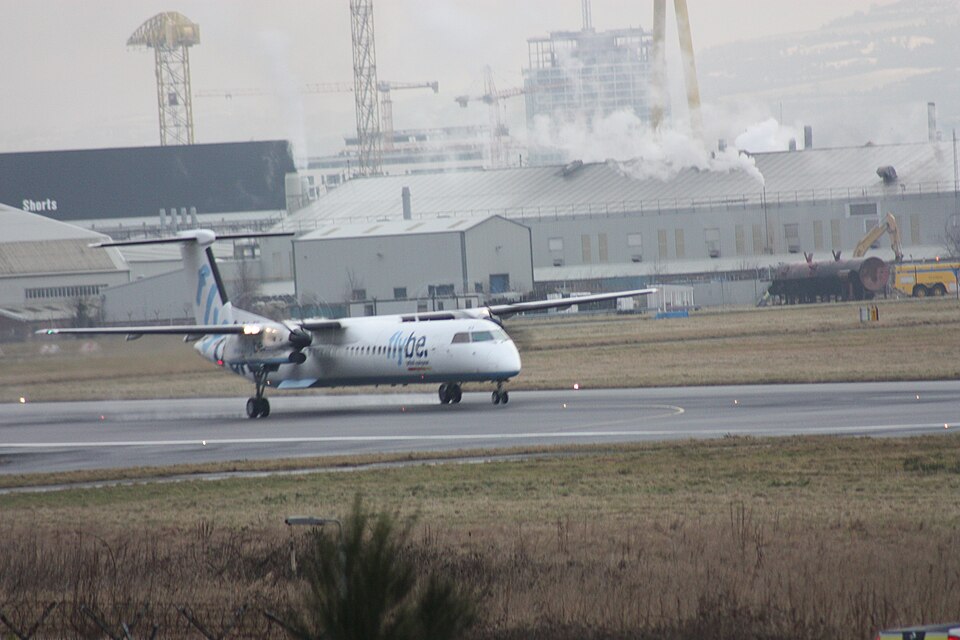
On 30 December 2014, a DHC-8-402 Dash 8, registration G-JECI, was operating a scheduled passenger service from Southampton Airport to Belfast City Airport. The aircraft carried 69 passengers and 4 crew. As the aircraft descended through Flight Level 150, the smoke caption on the flight deck Caution and Warning Panel illuminated briefly. The commander directed the first officer to don an oxygen mask, and as he did so, the smoke warning reappeared. The commander made a PAN-PAN call to alert air traffic control (ATC) and warned the cabin crew of a potential emergency. Shortly thereafter, the first officer noted that the extinguisher light for the aft baggage compartment had illuminated. The flight crew performed the appropriate actions, including pressing the switchlight to discharge fire extinguishant into the compartment. The commander then declared a MAYDAY and requested expeditious routing. The senior cabin crew member reported no smoke in the passenger cabin. Communication on the flight deck was hampered because both pilots were wearing oxygen masks. The smoke warning subsequently extinguished.
Descent and Landing
As the aircraft prepared to land, the commander briefed the senior cabin crew member, indicating that a passenger evacuation after landing might be necessary but stressing the need to wait for a positive command. Shortly before landing, the smoke warning reappeared, though again no visible smoke was present in the cabin or flight deck. On short final approach, the commander attempted to contact the Airport Fire and Rescue Service on frequency 121.6 MHz, but received no response. After landing, he brought the aircraft to a stop on the runway and shut down the engines. ATC informed the crew that there were no external signs of smoke or fire. With no smoke in the cabin, the commander ordered a rapid disembarkation.
Disembarkation and Examination
The aircraft had been dispatched with unserviceabilities affecting the public address (PA) system; the PA was unserviceable at the senior cabin crew member's station and the emergency system was also inoperative. This required the rapid disembarkation PA to be given from the aft cabin crew station, with the senior cabin crew member using a megaphone. The crew had previously discussed this scenario. The rapid disembarkation was successful, and no injuries were reported.
Subsequent examination by the operator's engineering department found no evidence of fire or smoke damage. The fire detection system appeared to function normally, but the smoke detectors and fire detection control amplifier were replaced as a precaution. A strip examination of the smoke detectors revealed corrosion on one electrical connector pin. The fire detection control amplifier showed no defects.
Probable Cause
Corrosion on a smoke detector connection pin was identified as the probable cause of the smoke warnings. The aircraft operator shared its findings with the manufacturer and suggested that routine maintenance of smoke detector connections be considered for inclusion in the scheduled maintenance programme.