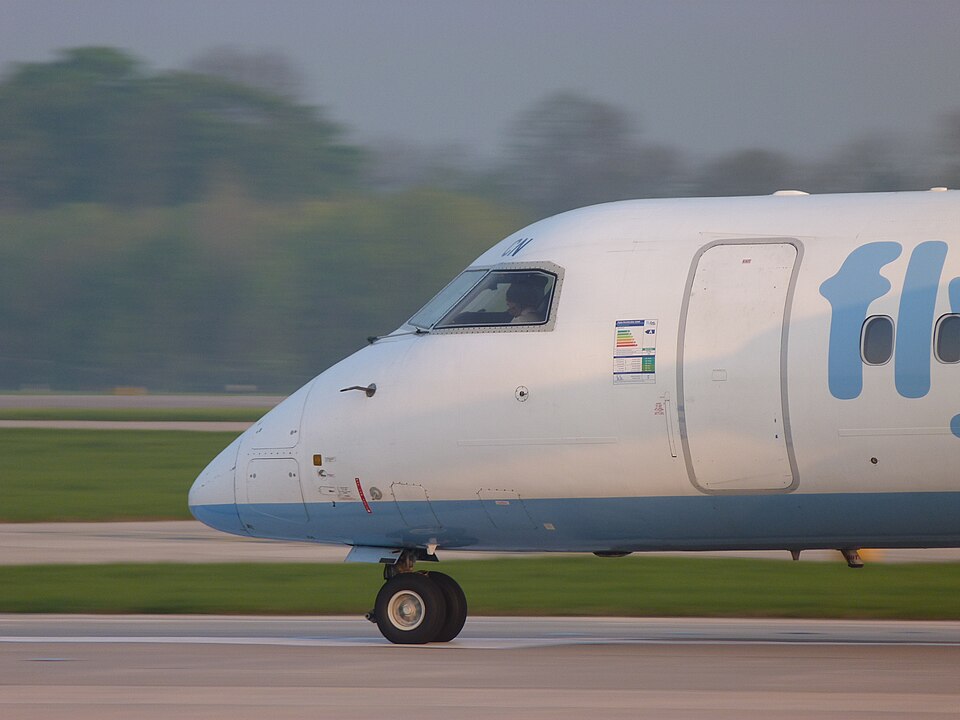
Accident Details
On 2 March 2019 at 1505 UTC, a Bombardier DHC-8-402 Dash 8, registration G-JECN, was operating a commercial passenger flight arriving at Southampton Airport. The aircraft had 4 crew and 59 passengers on board; no injuries were sustained. The aircraft sustained impact marks to the fuselage behind the radome, a nose landing gear door, and propeller tip strikes on the No 2 propeller.
Sequence of Events
After landing, the crew completed an over-speed governor (OSG) check as per the operator's policy for the last flight of the week. The No 1 engine was then shut down in accordance with standard operating procedures. During taxi to Stand 8 at walking pace, the commander applied the brakes but they had no effect. He applied reverse thrust on the No 2 engine, which slowed the aircraft but did not prevent impact with signage and a ground power unit (GPU). The co-pilot then noticed the standby hydraulic pressure and PTU control switches were off and turned them on, but the aircraft had already struck the objects.
Systems Background
The DHC-8-402 has two 3,000 psi hydraulic systems. The No 1 hydraulic system powers the flying controls, flaps, inboard roll spoilers, and wheel brakes. It includes a standby power unit (SPU) that pressurizes the system when the No 1 engine is not running. The No 2 hydraulic system powers additional controls, nosewheel steering, and emergency parking brakes. A PTU connects the systems. The approach checklist requires selecting hydraulic and fuel pumps on and confirming SPU and PTU advisory lights are illuminated.
Probable Cause
The accident was caused by the aircraft standby (hydraulic) power unit (SPU) not being selected to on. This selection was normally made during approach checks, but the checks were not completed prior to landing. Consequently, the mainwheel brakes did not function when the No 1 engine was shut down.
Commander's and Operator's Observations
The commander identified several contributing factors: failure to adhere to SOPs (approach checks not carried out, after-landing checks interrupted by OSG check), false confirmation (brakes worked with both engines running), sequence interruption (short taxi limited time for after-landing sequence), complacency (three previous normal arrivals), and a startle factor that led to using reverse thrust instead of the emergency brake. The operator considered that the approach checks and after-landing checklist should have captured the incorrect configuration. Safety actions include a NOTAC requiring a No 1 hydraulic system check during taxi and a study on checklist design and single-engine taxi risks.