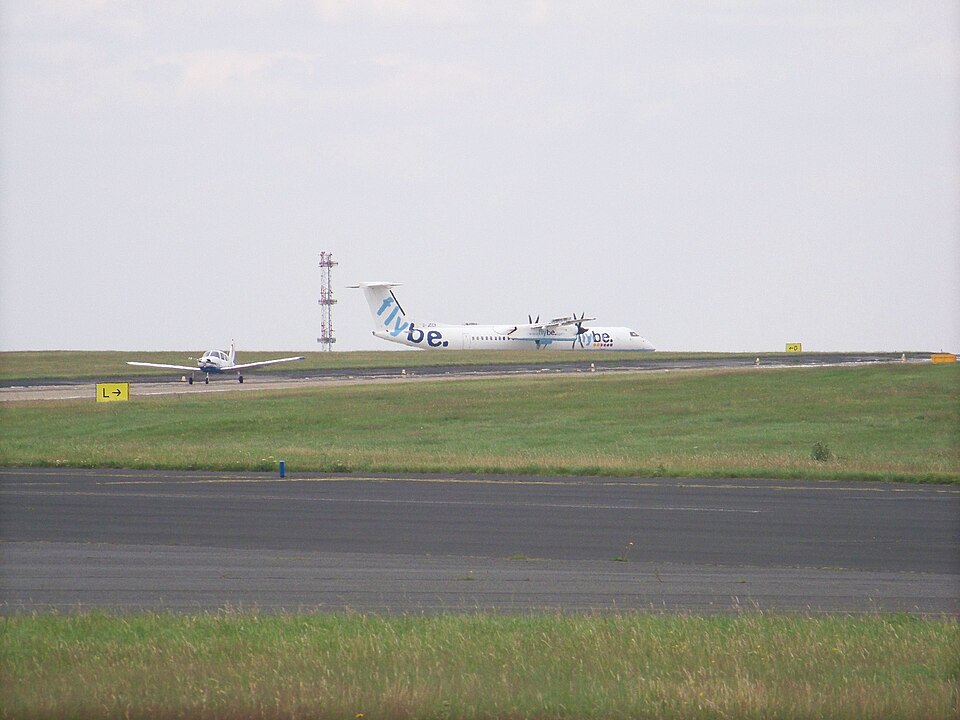
Accident Details
On 17 April 2018 at 1205 UTC, a De Havilland Canada DHC-8-402 Dash 8, registration G-JECX, operated by a commercial air transport company, was landing at Newquay Airport, Cornwall. The aircraft was on its third sector of a four-sector day, from Manchester to Newquay. The crew consisted of four, with 55 passengers on board. One cabin crew member reported minor back pain; no other injuries were reported. The aircraft sustained damage to several skin panels, frames, stringers, and the aft pressure bulkhead.
Flight History
The crew had operated two earlier flights to Amsterdam and back without incident. The third sector to Newquay departed 1 hour 20 minutes late. Weather at Newquay included low cloud, light rain, and a moderate wind. The co-pilot was the pilot flying for the sector. The first approach was discontinued due to displacement from the runway centreline, and a go-around was flown.
During the second approach, wind was reported as 190°/20 kt. At approximately 50 ft, the co-pilot reduced power to flight idle to control airspeed, though neither pilot was aware of the extent of the reduction. At about 30 ft, a high sink rate developed. The commander called "power, power, power." The co-pilot increased power and pitched up, but the aircraft tail struck the runway before the main wheels touched down. The aircraft bounced, and the commander took control. Observing the 'TOUCHED RUNWAY' light, he elected to continue the landing. The aircraft landed and taxied to the gate without further incident.
Recorded Data
Flight Data Recorder (FDR) data showed that torque reduced at about 100 ft, increased at 80 ft, then reduced to idle at 40 ft. At approximately 20 ft, power increased markedly and pitch attitude increased. The tail touched the runway at 2.1g with a pitch attitude of 10° nose up. The main wheels touched 4.8 seconds after the tail.
Aircraft Information
The DHC-8-402 engines are mounted on the wing, and a decrease in torque reduces lift from propeller airflow. The operator uses Flap 15 or Flap 35 for landing; Flap 15 was used. Normal pitch attitude for Flap 15 approach is about 3°, with a flare increase of 1-2°. The operator's manual states that a pitch attitude greater than 6° on touchdown can lead to a tail strike. The pilot monitoring is required to call "PITCH FIVE" at 5°. The manual instructs that if pitch reaches 6° or a non-normal sink rate develops, the pilot flying must respond with "correcting" and increase power only, without further pitch increase.
Meteorological Conditions
During descent, the ATIS reported: landing Runway 12, surface wind 210/16, visibility 3,500 m in light rain, cloud broken at 400 ft, temperature 12°C. The tower later gave wind as 190°/20 kt.
Organisational Information
The operator's stable approach criteria include an approach gate at 1,000 ft and a landing gate at 500 ft. The second approach met criteria until about 50 ft.
Conclusion
The tailstrike occurred because the pilot flying reacted instinctively to the high sink rate by increasing pitch attitude and power, rather than increasing power only. The aircraft manufacturer recommends annual recurrent pitch awareness training for flight crews.