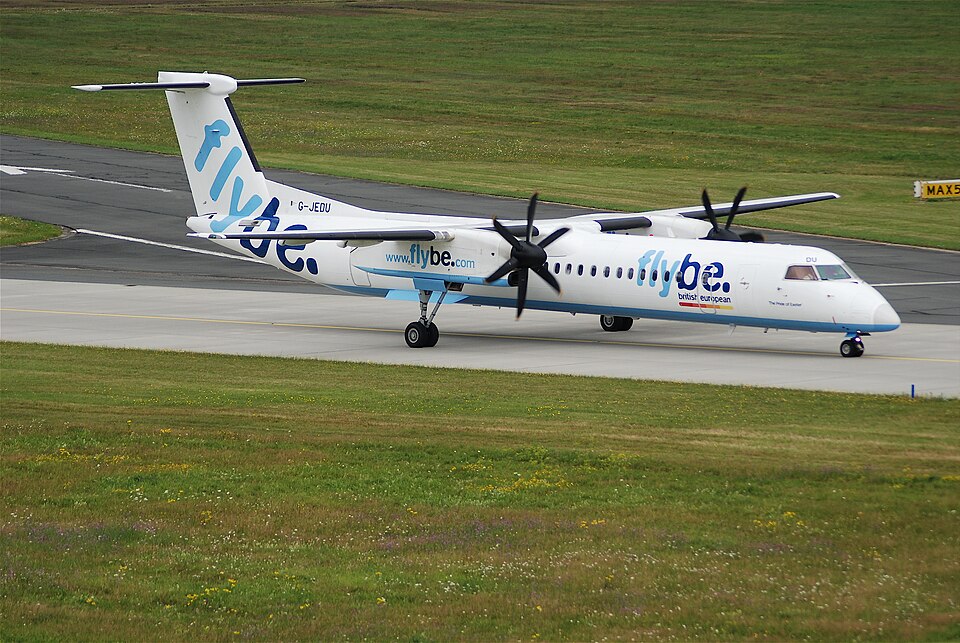
History of the Flight
On 10 November 2017, a DHC-8-402 Dash 8 Q400, registration G-JEDU, was operating the third sector of a four-sector day from Belfast City Airport to Inverness Airport. After takeoff from Runway 22 at 1118 hrs, the landing gear was selected up. The landing gear control panel indicated that the main landing gear (MLG) retracted normally, but the nose landing gear (NLG) did not. The crew observed that the nose door light and the light in the landing gear selector lever remained illuminated.
The crew maintained airspeed below 185 kt and climbed to 4,000 ft, entering a hold near waypoint Magee. They performed abnormal checklists for landing gear failure to retract and failure to indicate locked down. The MLG lowered and indicated locked, but the NLG showed an unsafe indication. They attempted alternate landing gear extension, pulling the NLG release handle multiple times, but the NLG did not extend.
After consulting with their company, the crew decided to divert to Belfast International Airport. They briefed passengers, moved those near propellers, and prepared for an emergency evacuation. The aircraft left the hold at 1320 hrs with 1,100 kg of fuel and conducted an ILS approach to Runway 25. At 200 ft, the co-pilot gave a brace command over the PA.
The aircraft touched down on the main wheels at 1332 hrs. The nose was gently lowered onto the runway. After stopping, the commander ordered an evacuation. Cabin crew opened the forward left door and rear doors. Some passengers required assistance exiting due to the nose-down attitude. Smoke and smell of burning entered the flight deck but cleared when the door was opened. All occupants evacuated, and the fire service transported passengers to the terminal.
Accident Site and Aircraft Examination
The aircraft came to rest with the nose on the ground, approximately 1,973 m from the Runway 25 threshold and 15 m to the right of the centreline. The NLG remained retracted with forward doors open. Abrasion damage was found on the lower forward fuselage and VHF antenna; the NLG forward doors had separated.
Examination showed the NLG alternate release handle had been pulled, with about 12 cm of cable exposed. The NLG was not centred; the wheels were turned to the right, and the right tyre was jammed against the NLG bay wall. The uplock could be heard releasing when the cable was pulled, but the NLG did not extend.
Findings
Investigation determined that a damaged electrical harness on one of the NLG proximity sensors caused an erroneous signal, leading the forward NLG doors to begin closing while the NLG was still in transit. The NLG tyres contacted the doors, rotating the NLG off-centre. Although the NLG retracted, the forward doors remained open and the tyres became jammed in the NLG bay, preventing NLG extension when commanded.
The harness damage resulted from a cyclically-driven fatigue failure mechanism, caused by the harness being secured with a non-flexible cable tie that restricted its movement during normal NLG operation.
Manufacturer and Operator Actions
The aircraft manufacturer clarified NLG proximity sensor harness routing and attachment instructions in the Aircraft Maintenance Manual and published inspection requirements. The operator conducted inspections on its Dash 8 Q400 fleet and rectified any anomalies. The aircraft and landing gear manufacturers are working on a more flexible harness design, an effort initiated before this event.