History of the Flight
The pilots were operating a four-sector duty with two return flights from Newquay Airport to London Heathrow Airport. The first sector was uneventful. On the second sector, weather at Newquay included strong northerly winds with turbulence and gusting crosswind near the aircraft's limit of 32 kt. After landing at 1723 hrs, the commander considered the landing firm and requested engineering assistance. Maintenance control checked flight data and dispatched an engineer; the landing was within limits. The aircraft departed for Heathrow at 1914 hrs, approximately 25 minutes late.
Due to strong gusting winds, the commander was pilot flying (PF) for departure with the co-pilot to assume control once airborne. Routine control checks during taxi appeared normal. During departure, conditions were described as "quite rough with a lot of drift." At 1,000 ft aal, the commander engaged the autopilot (AP) and passed control to the co-pilot, who initiated a right turn towards DAWLY using the AP.
The co-pilot noted the aircraft "struggled" to maintain the right turn and informed the commander that the handwheel was significantly deflected to the right to maintain wings level. The commander observed the handwheel displaced approximately 30° to 40° to the right; trim was normal and spoilers retracted. With the AP disengaged, the handwheel displacement persisted, but the aircraft felt in trim with no unusual feedback. The AP was re-engaged and control returned to the co-pilot. The crew stopped their climb at FL200. The co-pilot noted that handwheel deflection increased with airspeed, which he attributed to the scheduled de-activation of outboard spoilers at 170 KIAS.
The commander contacted company operations for engineering advice but received no helpful response, then informed them of his intention to divert to Exeter Airport, a company engineering base. A direct track to the EX NDB was approved by ATC. The cabin crew were briefed. During descent, the co-pilot observed increasing control deflection to maintain wings level. The pilots consulted the Quick Reference Handbook (QRH) but found no applicable checklists. As the aircraft neared the NDB, the cabin was not ready for landing, so the commander entered the Hold. As airspeed reduced, outboard spoilers became active and handwheel deflection decreased. The crew declared a PAN to Exeter ATC.
The commander requested left turns, as the handwheel was deflected right. Once the cabin was secured, the aircraft positioned for a left-hand downwind approach to Runway 08 with the commander as PF. Weather at Exeter was better, with slight crosswind from the left. The commander deselected the AP early and recalled a slight pull to the right but found the aircraft completely controllable. The approach and landing were uneventful at 1955 hrs.
Aircraft Damage
Post-flight examination revealed the lower left aileron cable had broken just outboard of the engine where it passed over a pulley accommodating a change in wing dihedral. No other damage was found.
Meteorological Conditions
The Met Office reported that at Newquay around 1900 UTC on 14 November 2019, there were strong winds with a band of cloud and rain. Surface winds were 22-24 kt gusting 32-36 kt from 020°. Forecast data indicated wind speeds at 500 ft and 1,000 ft around 30 kt and 40 kt respectively, with moderate to severe low-level turbulence.
Relevant QRH Checklists
The pilots did not find any relevant checklists in the QRH during the transit. However, the manufacturer advised that a checklist titled "Roll Control Malfunction - Aircraft rolls with no Control Wheel Input" was applicable.
Aircraft Information
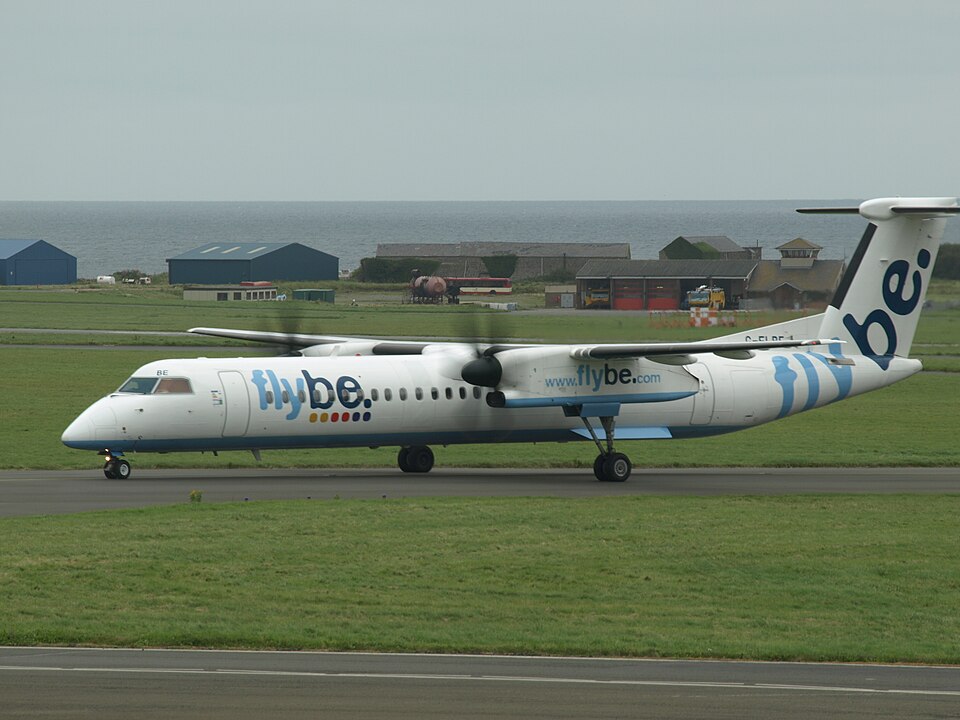
G-FLBE, a De Havilland Canada DHC-8-402, was manufactured in 2009 and had accrued approximately 22,400 flying hours. Roll control is achieved via ailerons and spoilers. The aileron control system uses cables routed along the wing rear spar.