History of the Flight
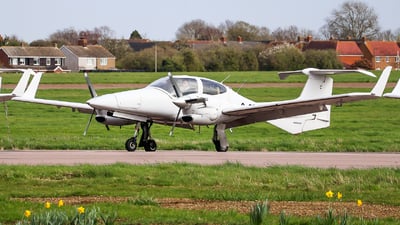
The accident occurred on 28 April 2016 at 1603 UTC after a training flight landing at Bournemouth Airport, Dorset. The aircraft, a Diamond DA42 Twin Star (registration G-CTCB), was being flown by a student pilot in the left seat with an instructor (the commander) in the right seat. A second student pilot occupied the rear seat. The approach to Runway 26 was a practice asymmetric power approach with the left engine set to zero thrust (about 18% power). The wind was from 230° at 15 kt, giving a 7.5 kt crosswind from the left. The instructor reported a stable approach with good speed control. A few feet before touchdown, the student closed both power levers and corrected drift using rudder pedals. Touchdown was firm but not hard, with almost full drift correction and the aircraft aligned with the runway. Deceleration was normal, and the aircraft maintained the centreline. At touchdown, a continuous beeping noise was heard, initially mistaken for a stall warning but identified as the landing gear unsafe warning. The left main gear green light was off and the red unsafe light flashed. The instructor took control, vacated the runway via the nearest taxiway after reaching a safe speed. The aircraft remained controllable but with increasing difficulty. After stopping on the taxiway and shutting down the engines, the instructor observed that the left main landing gear had partially collapsed. He instructed the student pilot and passenger to exit carefully.
Aircraft Examination
Examination revealed that the composite drag brace rib, which secures the left main landing gear drag brace to the centre wing section, had detached. This caused the left main landing gear leg to partially collapse. The aircraft manufacturer examined the aircraft and removed the failed rib for detailed analysis. They determined that the failure pattern was typical of an overload failure of the bonding between the composite rib and the composite centre wing section. They concluded that some damage had occurred during a previous hard sideslip landing, with the final failure occurring on the day of the accident.
Previous DA42 Failures of the Landing Gear Drag Brace Rib
The DA42 type has experienced multiple failures of the landing gear drag brace rib, attributed to improper bonding of the rib to the centre wing section. In response, the manufacturer issued Mandatory Service Bulletin (MSB-42-031/1) in 2007 to inspect the bonding and carry out repairs if inadequate. According to G-CTCB's airframe logbook, this MSB was performed on 13 February 2007, and the manufacturer found physical evidence that the repair had been correctly applied. Since the MSB was issued, the manufacturer received 11 reports of failures of the main landing gear drag brace rib. Four of these were due to incorrect MSB implementation, one was caused by a storm spinning the aircraft while parked, and the remaining cases were attributed to overload events.