Synopsis
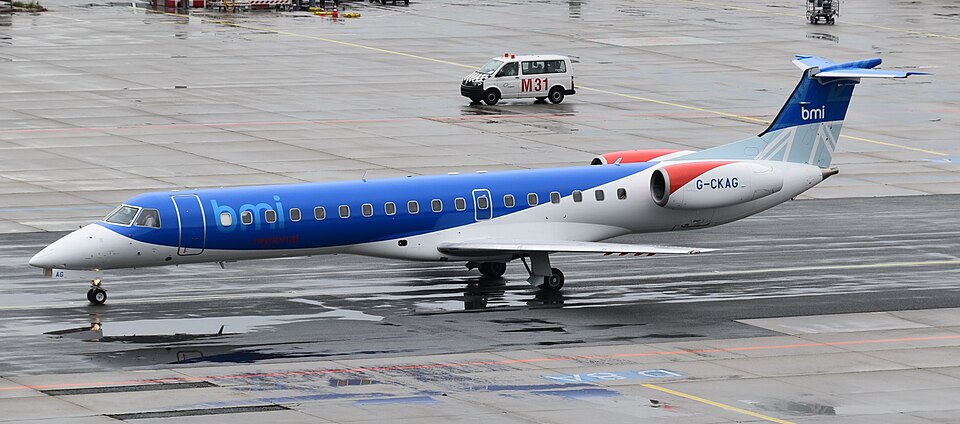
The flight crew of an EMB-145EP, registration G-CKAG, were conducting an ILS Category II approach and landing on Runway 27 at Bristol Airport. On touchdown, the aircraft de-rotated sharply. The pilot flying (PF) was unable to maintain directional control during the landing roll and the aircraft ran off the left side of the runway onto the grass. During the landing, the throttles were moved forward, reducing deceleration. As the aircraft left the paved surface, the crew realized the landing had been carried out with the Emergency/Parking brake set. The aircraft may have remained on the runway but for the addition of forward thrust.
History of the Flight
The crew reported for duty at 0540 hrs for a round trip from Bristol to Frankfurt; the accident occurred on the return sector. The left seat was occupied by a captain-under-training, new to the operator and aircraft type; the right seat was occupied by a company training captain, who was the commander. The outbound sector was uneventful, with the captain-under-training as PF.
The return sector was also flown by the captain-under-training. A Category II approach was planned due to forecast fog. The approach briefing began during descent at 1113 hrs but was deferred for ATIS. The crew noted the 1050 hrs Bristol ATIS: Runway 27, damp surface, low visibility procedures in force, variable wind 3 kt, visibility 150 m, RVR 400 m, fog. The briefing resumed but was interrupted by weather information, ATC instructions, and cabin crew communications.
At 1120 hrs, London ATC instructed descent to FL160 and speed reduction to 250 kt, and advised holding. At 1125 hrs, Bristol ATC confirmed the approach. The PF decided to deploy speed brake but FDR data did not indicate deployment. At 1130 hrs, the commander suggested speed brake use; the PF then deployed it. The crew requested extra track miles, which was granted.
During the approach checklist, at the second item, the commander read "park brake" instead of "Seatbelt Sign ON"; the PF responded "on". An ATC instruction interrupted, and the commander restarted the checklist from the beginning, completing it correctly. At 80 ft agl, the PF disconnected the autopilot for a manual landing.
On touchdown, the PF noted rapid de-rotation and difficulty maintaining directional control. The commander advised taking feet off brakes, thinking the PF was "riding the brakes." The PF attempted using the steering tiller; the commander told him not to. The aircraft ran left off the runway onto grass, stopping after 120 m. The commander then realized the parking brake was on. The thrust levers had been advanced during the confusion; the PF closed them when stopped.
The crew assessed the aircraft was safe and did not evacuate. The commander contacted ATC, and the PF made an announcement for passengers to remain seated. ATC activated crash alarm and RFFS arrived within three minutes. The captain-under-training later identified he likely set the parking brake instead of deploying the speed brake.
Meteorological and Airfield Information
At the time, a ridge of high pressure gave light and variable surface flow. The 1120 hrs meteorological report: surface wind variable 2 kt, visibility 300 m, RVR 500 m, fog. Bristol Airport does not record LVP frequency, lacks surface movement radar, and fog can prevent ATC visual observation. A Fog Search Plan exists for suspected accidents or communication loss.
Personnel and Recorded Information
The captain-under-training had 17 hours on the Embraer 145, this being his eighth sector and fourth Category II approach. The CVR and FDR recovered over two hours of audio and 50 hours of data. No parking brake parameter was recorded. At ATC handover, the PF intended to set speed brake but its parameter did not change.