Overview
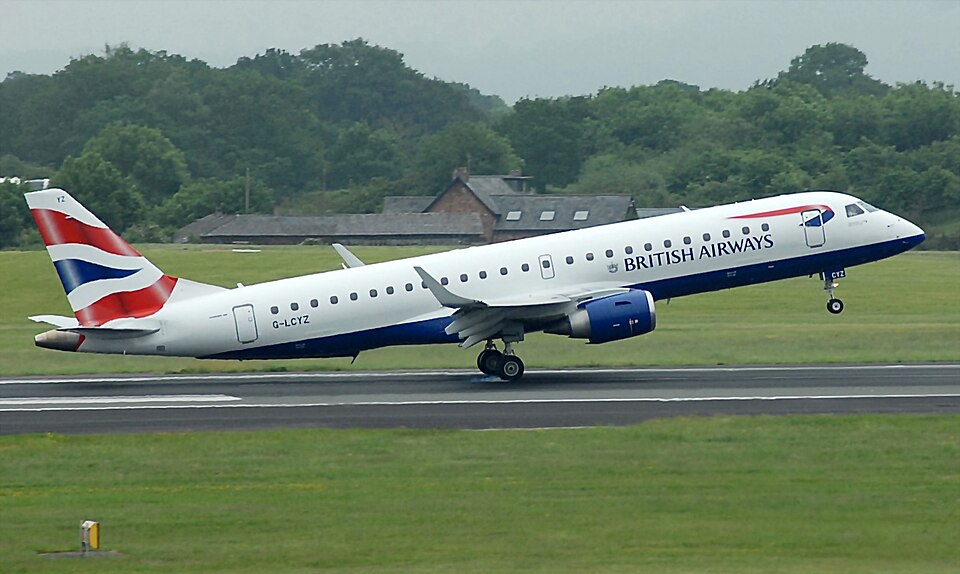
On 11 December 2018, an Embraer 190-100 SR (registration G-LCYZ) operated a commercial passenger flight from London City Airport (LCY). The aircraft was the first flight of the day for the crew, who reported being well-rested. The co-pilot was designated as Pilot Flying (PF), and the commander served as Pilot Monitoring (PM). The aircraft had 4 crew and 86 passengers on board; no injuries were reported.
History of the Flight
During cockpit preparation, both pilots independently calculated takeoff performance using electronic flight bags (EFBs). After agreeing on the takeoff settings with the PF, the commander entered them into the flight management computer. The required thrust setting per the airline's Standard Operating Procedures (SOPs) was T/O-1. However, as the aircraft accelerated through 60 kt during the takeoff roll, the commander noticed that 'Takeoff 3' (T/O-3) was displayed on the Engine Indicating and Crew Alerting System (EICAS). The T/O-3 setting reduced maximum available thrust from 18,500 lbf to 15,450 lbf per engine.
Neither pilot could recall whether the T/O-3 setting was incorrectly read out or misheard as T/O-1 during the Vital Data Review (VDR). Concerned that the incorrect thrust setting invalidated the rejected takeoff stopping distance calculations, the commander deemed continuing the takeoff the safest option. As PM, the commander called V1 at the calculated speed but delayed the Vr call by approximately 5 kt to compensate for reduced thrust. The PF experienced no handling difficulties, and the departure continued without incident.
After reaching FL100, the crew recalculated takeoff performance assuming T/O-3 thrust. The calculations indicated they could have stopped safely up to V1, but climb performance might have been compromised had an engine failed shortly after takeoff.
Recorded Information
With no appreciable headwind, the aircraft reached V1 after a ground roll of 560 m, using about 41% of the available 1,360 m runway length. Data from a previous departure using T/O-1 at a comparable weight (but with unknown headwind) required a 440 m ground roll to reach V1.
Aircraft Information
The Embraer E190 has two thrust de-rate settings: T/O-2 and T/O-3, activated via the Multi-Purpose Control and Display Unit (MCDU). The Automatic Takeoff Thrust Control System (ATTCS) can automatically increase thrust to a reserve level (RSV) on the remaining engine if one fails. Had an engine failure occurred, the ATTCS would have increased thrust on the live engine from 15,450 lbf to 17,100 lbf (T/O-3 RSV). Advancing thrust levers from TO/GA to MAX would command T/O-3 RSV on both engines. De-rate settings are automatically cancelled when climb power is selected, or may be manually deselected via the MCDU. No automated system alerts pilots to an inappropriate takeoff thrust setting beyond the EICAS display.
Human Factors
The crew could not determine why the slip occurred or went undetected. The commander had flown almost exclusively the E170 (a common type rating variant) in the two weeks prior, where T/O-3 is often the required de-rate. This may have contributed to the initial error and confirmation bias when reviewing the EICAS display. The flight crew did not assess that advancing thrust levers to command T/O-3 RSV was necessary for safe flight.
Analysis and Conclusion
Evidence suggests that T/O-3 was manually selected in error following correct performance calculations. Normal human performance limitations likely contributed to the setting remaining undetected during the VDR. Subtle variations from operating different common type variants played a role. The aircraft departed with a power setting that may have adversely affected handling and performance in the event of an engine failure. The commander did not consider manually de-selecting the de-rate as safe, nor believed T/O-3 RSV thrust was required. Performance-related errors remain a threat to commercial operations; procedural barriers and future automated systems are key risk controls.