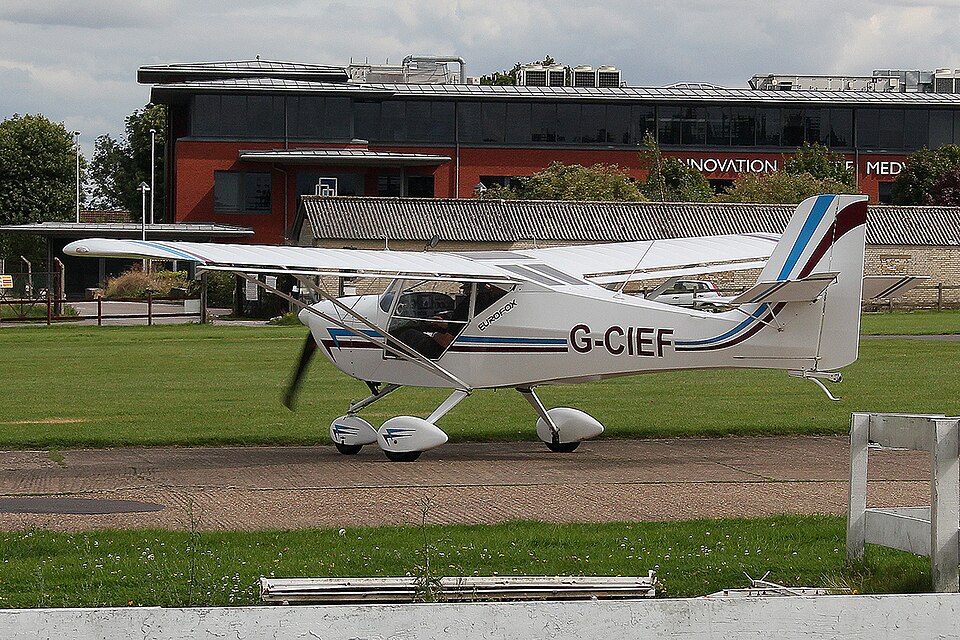
History of the Flight
The pilot, a 75-year-old holder of a Light Aircraft Pilot’s Licence with 719 hours of flying experience, arrived at the gliding club on the morning of 26 July 2023. He first flew a short solo flight at around 0807 UTC, followed by two aerotow launches. The accident flight, which began at 1107 UTC, was an aerotow launch for a glider conducting spin recovery training. The glider released from the tow at approximately 3,000 ft, after which the pilot of G-CIEF initiated a descending right turn, a standard release procedure.
Accident Sequence
After the glider released, G-CIEF descended in a right turn. Data showed a maximum descent rate of 3,000 ft/min, which later reduced to 2,000 ft/min. The aircraft maintained about 90 kt with bank angles up to 45°. When the aircraft passed the runway extended centreline at approximately 1,000 ft, it entered a left descending turn away from the final approach path. The left turn continued for about 30 seconds until the aircraft struck a field roughly 1 nautical mile from the airfield. The pilot was fatally injured, and the aircraft was destroyed. No radio call was made.
Recorded Data
Flight data was recorded by a FLARM electronic conspicuity device and a navigation app on a tablet. A dashcam from a nearby vehicle also captured the final seconds. The data showed that during the final left turn, the bank angle increased at about 2°/s, the descent rate rose to around 3,000 ft/min, and airspeed reached about 100 kt with a bank angle of 55° and load factor near 2 g. The time from the start of the left turn to impact was 30 seconds.
Investigation Findings
The AAIB investigation found no evidence of a technical malfunction. Although the postmortem report did not indicate a medical event, considering the pilot’s previous medical history, the investigation determined that the pilot may have experienced a partial or full medical incapacitation that rendered him incapable of controlling the aircraft.