Background
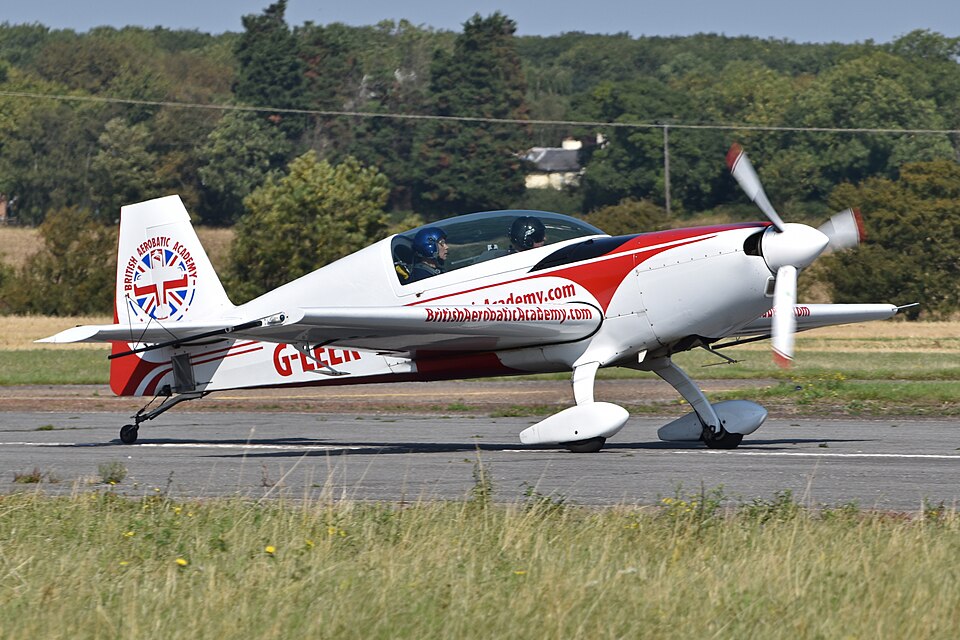
On 13 July 2024, an Extra EA-200, registration G-EEEK, departed Fowlmere Airfield, Cambridgeshire, for a private flight to Spanhoe Airfield, Northamptonshire. The pilot, aged 65, held a Private Pilot's Licence and had accumulated at least 4,076 flying hours, with approximately 1,100 hours on type. The aircraft, manufactured in 2006, was powered by a single Lycoming AEIO-360-A1E piston engine.
Accident Sequence
After arriving at Spanhoe, the pilot performed a flypast before pitching the aircraft into a vertical climb. During the climb, he completed at least four aileron rolls. At the apex of the climb, the aircraft was manoeuvred into an upright flat spin to the left. The aircraft completed at least four turns in the spin before descending below tree line and impacting the ground approximately 170 m south of Runway 09-27, adjacent to the airfield access road.
Wreckage Examination
The aircraft struck the ground in a wooded area. The compact nature of the wreckage and lack of significant forward debris indicated a low forward speed at impact. The fuselage's welded steel frame showed minimal distortion, and three-phase electrical cables above the wreckage were intact aside from minor fire damage. A post-impact fire consumed most flammable materials. The propeller was rotating under power at impact. The pilot was seated in the rear seat with the seat harness buckle present, but the straps were consumed by fire. The accident was not survivable.
Witness Reports
Witnesses reported seeing the aircraft climb vertically with rotation about the vertical axis, then fall into a descending rotation to the left. One witness described a flat spin. Engine noise was loud and at high power. CCTV analysis confirmed the vertical climb, aileron rolls, and flat spin, estimating a maximum height of about 1,200 ft agl during the climb.
Aircraft Examination
Fire damage prevented complete assessment of flying controls. Rudder control continuity was confirmed with no anomalies. Aileron and elevator control components were largely melted, but no pre-accident defects were identified on surviving parts. The engine disassembly showed mechanical continuity and good condition apart from heat damage. The fuel selector valve was melted, preventing determination of tank selection. The aircraft had a current Airworthiness Review Certificate and had undergone annual and 100-hour inspections.
Aircraft Performance
The Extra EA-200 is a two-seat aerobatic aircraft stressed to ±10g. Spins, including flat spins, are permissible. Recovery from a flat spin requires opposite rudder, power idle, neutral ailerons, and forward stick. In an upright flat spin, the pilot cannot see the ground due to lack of a transparent floor panel. The aircraft departed with an estimated 76 litres of fuel; the pilot's fuel management during the flight could not be determined.
Investigation
Unable to establish why the pilot conducted unapproved low-level manoeuvres. Control restriction or pilot incapacitation could not be excluded as reasons for the lack of recovery.