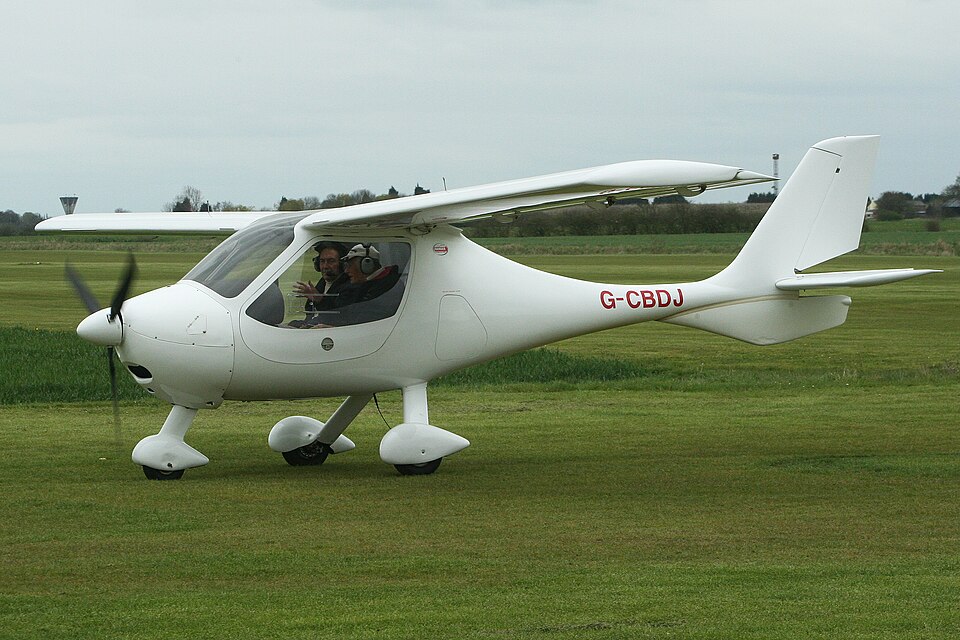
Synopsis
A Flight Design CT2K microlight, registration G-CBDJ, was destroyed when it struck the ground during a landing attempt at Beccles Aerodrome, Suffolk, on 24 March 2022. The sole pilot, aged 87, received fatal injuries. The approach was described as unstable; the aircraft bounced on landing and probably stalled.
Flight History
The flight originated from Temple Bruer airstrip, Lincolnshire, en route to Beccles. The pilot booked out at 1246 hrs and took off from Runway 08. Three minutes later, he reported a "slight problem" to Cranwell ATC and began returning to Temple Bruer. After about one minute, he advised the problem was solved and continued toward Beccles. The pilot operated at altitudes up to 3,500 ft amsl.
At 1350 hrs, he contacted Beccles Radio and was informed Runway 09 was in use with easterly winds less than five knots. He joined downwind and established on final approach. Eyewitnesses described the final approach as unstable in roll and pitch initially, then becoming stable before touchdown. The aircraft touched down on its main wheels approximately 50 m from the threshold, then bounced to about 10 ft. It touched down again on the nosewheel, bounced a second time, and pitched markedly nose up to about 45° as it appeared to climb. Reaching around 100 ft above the runway, the aircraft veered left, rolled to approximately 90° angle of bank, then the nose dropped and it fell to the ground in an adjacent field. No witnesses reported hearing an increase in engine power after the landing attempts. There were no reports of turbulence.
Accident Site
The aircraft came to rest about 100 m north of Runway 09 and 240 m from the threshold. Both wings had detached from the fuselage, with the lower surfaces uppermost. The fuselage lay on its right side, on top of the wings, with severe disruption to the nose section. The field contained a rapeseed crop about 1 m high, with heavy damage near the aircraft and a short swath consistent with the left wingtip making first contact.
Aircraft Information
G-CBDJ was a Flight Design CT2K microlight built in 2001. It featured all-composite construction, a high wing, conventional controls, and tricycle landing gear. The engine was a Rotax 912ULS driving a three-bladed propeller. The aircraft was equipped with a Ballistic Parachute Recovery System (BPRS), which was later deployed at the accident site.
The instrument panel included a Brauniger Alpha Multi-Function Display (MFD) that showed fuel quantity, indicated airspeed, altitude, vertical speed, engine rpm, temperatures, and oil pressure. The MFD recorded peak values from the accident flight and 23 previous flights. It also recorded flight duration when the aircraft climbed above 75 ft and airspeed exceeded 27 kt.
Recorded Data
Radar and electronic conspicuity data provided position and altitude information. Radio communications showed the pilot's initial contact with Cranwell ATC, the "slight problem," and the subsequent "problem solved." After leaving the Cranwell MATZ, the pilot switched to a safety frequency and no further communications were recorded. The final data point at 1354:58 hrs showed the aircraft on final approach, 800 m from the runway threshold at 430 ft amsl (350 ft aal), with a descent rate consistent with a 7° flight path angle.
Medical and Licensing Information
The pilot held a Private Pilot’s Licence and had 2,677 total flying hours, of which 1,621 were on type. In the last 90 days, he flew 20 hours; in the last 28 days, 9 hours. He was 87 years old.
Investigation
The AAIB investigation noted that the pilot was familiar with his aircraft and recent practice, but the landing diverged from his intended plan. The report suggested that age-related deterioration in human performance might have been a factor, given the pilot's age and recognition that he would soon have to stop flying. The investigation highlighted a lack of medical guidance for pilots and medical professionals regarding age-related deterioration, and that some private pilots are not subject to independent professional assessment. Four Safety Recommendations were made to the CAA concerning the Pilot Medical Declaration and revalidation of ratings.