Introduction
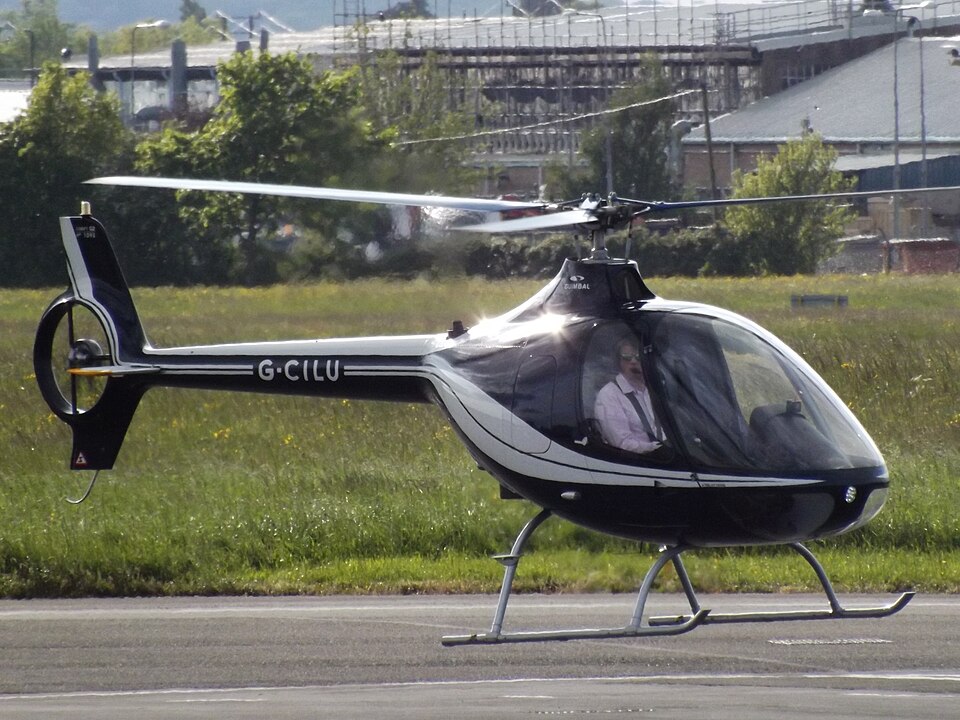
On 29 June 2016, a Guimbal Cabri G2 helicopter, registration G-CILU, was involved in an accident at Cotswold (Kemble) Airport, Gloucestershire, during a training flight. The aircraft sustained damage to its main rotor blades, landing skids, fuselage, and tail. Both occupants, a student pilot and an instructor, were uninjured.
History of the Flight
The helicopter was engaged in a dual training flight with a student pilot and an instructor on board. At the time of the accident, it was operating within the airfield perimeter, to the south of Runway 08/26. The weather was fine, with a surface wind from 220° at 15 to 25 kt.
The student was tasked to fly a downwind 'quick-stop' manoeuvre, which required that the helicopter first be established in downwind flight at 30 ft agl and 60 kt IAS. The intended profile for the manoeuvre was a left turn and flare, bringing the helicopter to a hover headed into wind.
Sequence of Events
The manoeuvre proceeded normally until the mid-point of the turn, when the low rotor rpm warning horn sounded and the helicopter descended rapidly. The instructor later reported that the student had 'over pitched' the main rotor blades in response to a sudden loss of height which was induced by turbulence.
As the warning horn sounded, the instructor announced "i have control" and attempted to level the helicopter. The student pilot appeared not to release the controls immediately which, combined with the very limited time available, meant that the instructor was unable to regain controlled level flight before the main rotor blades struck the ground.
Damage and Outcome
The helicopter skidded upright over the grass surface before coming to a stop. The occupants, who were uninjured, vacated the helicopter through the main doors. The aircraft suffered damage to its main rotor blades, landing skids, fuselage, and tail.
Probable Cause
The AAIB bulletin did not state a formal probable cause. The instructor’s report indicated that the student over-pitched the main rotor blades due to turbulence-induced loss of height, but this is not presented as a definitive cause.