History of the Flight
The commander and a student pilot were conducting a PPL(H) skills test in the helicopter, with the commander in the left seat and the student in the right. After completing a navigation exercise and returning to Goodwood Aerodrome, they performed a simulated engine failure from the hover (SEFH) to a satisfactory standard, though the commander noted a slight right yaw. The weather was fine with wind from about 050° at 5 kt.
The student requested to repeat the SEFH, feeling he could improve. During the subsequent SEFH, the student recognized a right yaw and applied left pedal, after which the helicopter began a gentle descent. As he intended to raise the collective to cushion the landing at about 1.5 ft agl, the helicopter started a rapid left yaw. He applied full right pedal and handed control to the commander, who was already applying full right pedal. The commander moved the cyclic slightly forward but could not recall collective inputs. Witnesses saw the helicopter spin and climb to about 40 ft agl before descending and contacting the ground.
After coming to rest, the commander secured the helicopter. Airfield emergency vehicles and local authority ambulances arrived, and both pilots were extracted and taken to hospital with serious injuries.
Pilots' Comments
The student pilot stated that the first SEFH landing felt firm and he wanted to improve. On the accident SEFH, after the left yaw began, he felt the helicopter climb. Application of right pedal slowed the yaw rate. He tried to steady the helicopter with cyclic but did not recall handing over control. The forces were violent, forcing him sideways. He described being reactive to yaw during engine-off exercises.
The commander stated that for a SEFH, she announces “engine failure in 3, 2, 1, GO” and closes the throttle through the detent. She noted the student was slow applying left pedal on the first SEFH. She believes on the accident SEFH, the throttle may not have been fully closed before left yaw began, and the student may have anticipated left pedal before “GO”.
The student's instructor commented that the student was conscientious but could over-analyse and be excessively self-critical.
Flight Manual
Section 4 of the Cabri G2 Flight Manual, Normal Procedures, outlines the power failure in hover in ground effect practice. Steps include rolling off throttle frankly until on its stop, counteracting yaw with left pedal, increasing collective as ground approaches, and pushing collective down after landing. Notes indicate that if light, the helicopter may bounce; there is no natural tendency to depart in roll or pitch; and for forgiving practice, a maximum height of 5 ft is recommended.
Accident Site
The accident occurred in the Helicopter Training Area at Goodwood Aerodrome. The helicopter came to rest upright with the right side of the fuselage against the ground, pointing northeast. The left landing gear had penetrated the fuselage, the right passenger door was broken and detached, the fenestron tail rotor had detached, and two main rotor blades struck the ground. Both landing skids were dug into the ground with no evidence of movement after contact.
Helicopter Information
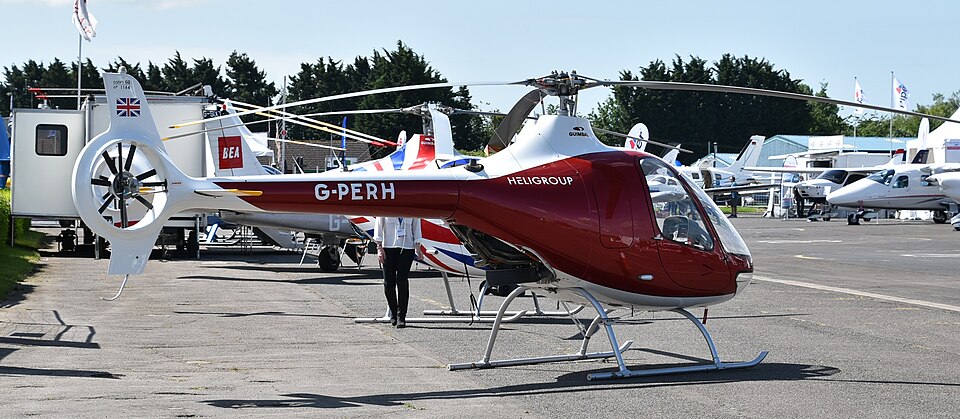
The Guimbal Cabri G2 is a light two-seat helicopter certified to EASA CS27 and FAA FAR-27. It has a carbon-fibre monocoque fuselage, a Lycoming O-360-J2A piston engine, a Fenestron tail rotor, and skid landing gear. The seats are composite shells with energy-absorbing struts designed for 19 g forward and 30 g vertical loads.
Engine controls include a twist-grip throttle on the collective lever, an electronic governor, and a correlation cam. The manufacturer noted that the main rotor can produce lift at rotor speeds below the authorised range, but the Fenestron thrust becomes insufficient for yaw control, and raising the collective aggravates the left spin.
Probable Cause
The source does not state a probable cause.