Introduction
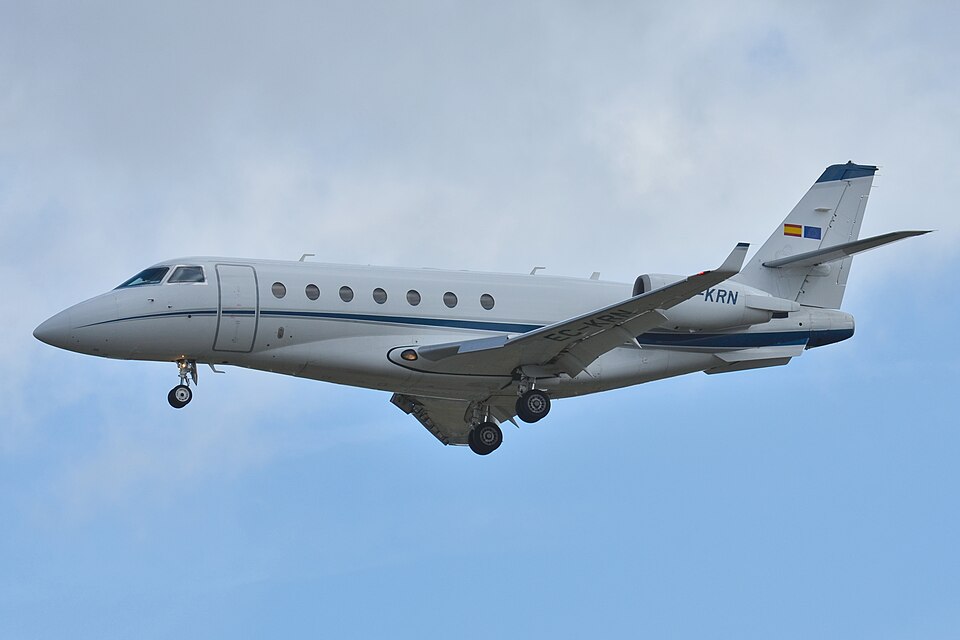
On 14 January 2015, a Gulfstream G200 aircraft, registration EC-KRN, was involved in a serious incident during landing at London Luton Airport. The aircraft, manufactured in 2008 (serial no. 188), was being operated as a commercial air transport passenger flight with three crew and three passengers on board. No injuries were sustained by any occupants. The incident resulted in damage to all four mainwheels and tyres.
History of the Flight
The aircraft had departed from Dakhla Airport, Morocco, and was on approach to London Luton Airport. The commander was the pilot flying (PF) and the co-pilot was not flying (PNF). The Digital Flight Data Recorder (DFDR) did not record the incident flight; the following sequence was established from the Cockpit Voice Recorder (CVR).
The descent was normal, with the aircraft vectored onto the ILS approach for Runway 26. The ATIS reported turbulence with wind from 180° at 17 kt gusting 31 kt, variable between 140° and 210°, and the runway reported as “wet-wet-wet”. The crew commented about a strong crosswind from the left. The aircraft was fully configured for landing and cleared to land with the tower advising wind from 190° at 18 kt gusting 28 kt. The autopilot was disconnected at approximately 1,800 ft. The PNF managed the thrust levers at the PF’s request due to turbulent conditions. The approach speed was set at VREF +10 kt (VREF was 129 kt based on a landing weight of 25,400 lb). As the aircraft approached ILS minima, airspeed was reduced to VREF +5 kt, and at about 50 ft the thrust levers were retarded towards idle. Within a second of touchdown, a loud bang was recorded on the CVR; the rate of descent at touchdown did not appear excessive. The PF reported braking difficulties and the PNF said “we have a burst tyre”. The PNF encouraged the PF to continue applying brakes, but the PF again questioned effectiveness. The PNF called for emergency braking to be selected about 16 seconds after touchdown. Two seconds later the emergency brake position was set, and two seconds after that a grinding sound started, likely from a wheel rim contacting the runway. Eight seconds after emergency brake selection, a loud short sound was recorded, followed by two further similar sounds two and seven seconds later—probably the three remaining tyres bursting. The grinding ceased as the aircraft stopped on the runway 38 seconds after initial touchdown. The fire service attended but were not needed.
Commander’s Report
The commander believed that after touchdown both right mainwheel tyres burst, with a couple of seconds delay between them. He thought both tyres had burst because he felt the aircraft lean to the right followed by a more pronounced inclination to the right. Maximum reverse thrust was selected. The anti-skid off light illuminated while the crew were regaining directional control. Only after the aircraft came to rest did he realise that all four mainwheel tyres had burst.
Aircraft and Systems Description
The Gulfstream G200 is a twin-engine business jet (formerly IAI Galaxy) with two Pratt & Whitney PW306A turbofan engines, operated by two crew and typically seating 8–10 passengers (maximum 19). The aircraft is equipped with normal and emergency hydraulic wheel brake systems. The emergency braking system, selected by placing the park/emerg handle in the emergency position, uses the left hydraulic system and bypasses the anti-skid control valves, providing lower pressure and reduced pedal sensitivity. The anti-skid system prevents wheel skidding and includes touchdown protection (no brake pressure until wheels spin up above 35 kt or 2.5–3.5 seconds after weight-on-wheel). The anti-skid off light illuminates when a failure is detected. The system also provides locked wheel protection: if one wheel speed drops below 30% of groundspeed, brake pressure is removed from that wheel and its paired wheel. The Gulfstream G200 Airplane Flight Manual states that after a tyre burst at speeds above 30 kt, a locked wheel condition may be detected, resulting in loss of braking on both wheels and illumination of the anti-skid off light. Selecting emergency braking restores brake pressure to all wheels at lower pressure. The Quick Reference Handbook (QRH) procedure for anti-skid off illumination during landing roll includes releasing brakes, reapplying if light goes out, or pressing the anti-skid pushbutton to turn off anti-skid and then applying brakes cautiously. The aircraft manufacturer stated that none of their QRH procedures are memory items, but that pilots are trained to handle such situations in a reflex manner.
Probable Cause
null