Introduction
On 24 August 2016, at 1024 hrs UTC, an HAV Airlander 10 registered G-PHRG was involved in an accident at Cardington Airfield, Bedfordshire. The aircraft was on a test flight with two crew members on board. No passengers were carried. The crew reported no injuries, but the aircraft sustained damage to the cabin flight deck area.
History of the Flight
The flight was the second test flight of the Airlander 10, with a test pilot and a flight test engineer. It un-masted at 0812 hrs in fine weather with a variable wind of about 2 kt. After 98 minutes, the aircraft approached its mooring mast successfully. However, the winch at the mast could not be started due to a diesel engine failure, preventing the aircraft from being secured. The pilot decided to take off again, and the mooring line was temporarily stowed but fell free, hanging to its full length of 155 ft (47 m). The pilot was incorrectly informed the line was about 50 ft long.
After the ground equipment issue was resolved, the pilot conducted a second approach. To avoid entanglement with trees or a fence, the approach was steeper than normal. However, at about 120 ft, the mooring line became entangled in wires crossing the approach path. Although freed, this contributed to a high final approach, with the aircraft arriving over the landing area at about 180 ft.
The aircraft was reluctant to descend, and with no forward airspeed, the pilot had limited control. He attempted to trim the aircraft nose-down by managing the center of gravity. At about 10° nose-down pitch, the aircraft suddenly pitched further to about 18° and descended. The pilot partially arrested the descent, but insufficient height prevented full recovery. The aircraft struck the ground in an excessive nose-down attitude, causing structural damage to the flight deck area. The accident occurred 2 hours 12 minutes after un-masting. Both crew evacuated through gaps in the damaged structure, with no injuries. The aircraft was later secured to the mooring mast.
Aircraft Information
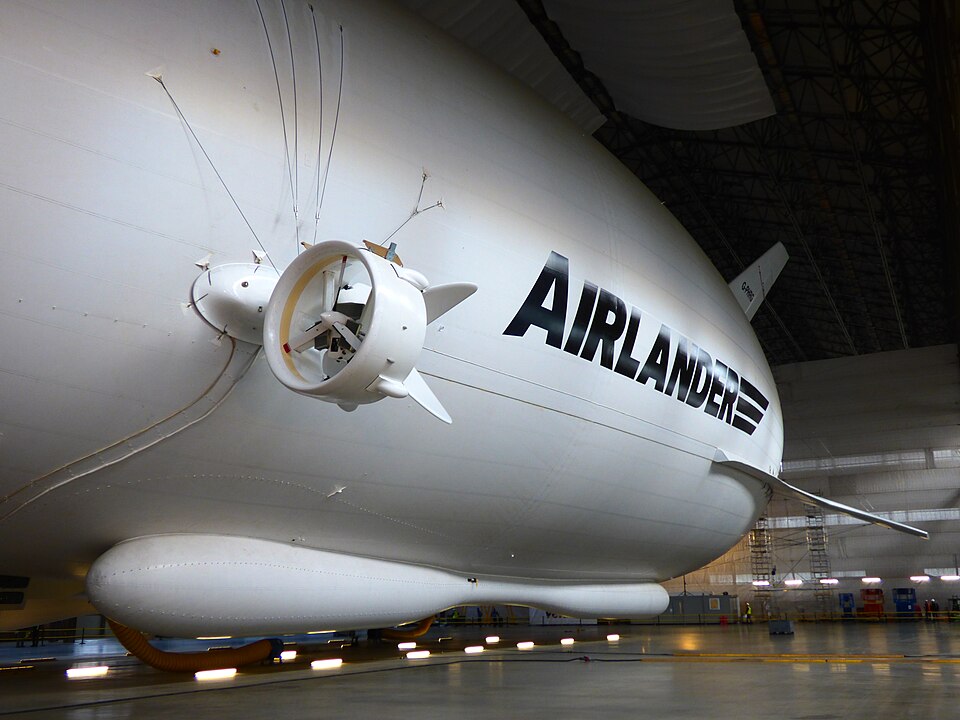
The Airlander 10 is a development of the HAV 304 hybrid aircraft, designed as a long-endurance surveillance platform. Its hull is a pressure-stabilized fabric structure containing helium and air. The aerodynamic shape provides up to 40% of total lift. It is 92 m long and powered by four turbocharged diesel engines (Technify Centurion C4.0), two forward and two aft, providing vectored thrust. The flight deck is at the forward end of the mission module suspended under the hull.
The aircraft's buoyancy is expressed as static heaviness. In normal operation, it has positive static heaviness, which reduces as fuel is burned and can be affected by precipitation and environmental warming. The intended landing profile involves a touchdown with forward airspeed and a short landing roll. It is not capable of true vertical landings in calm or very light wind conditions.
The mooring line is normally stowed within the Mast Mooring Interface (MMI). During mooring, the line is extracted and fed onto a winch at the mast.
Operator's Investigation Findings
The manufacturer/operator conducted an investigation. It determined that the higher approach was necessary to clear the mooring line, which had come to hang free due to a lack of proper stowage after extraction from the MMI. The high approach placed the aircraft outside its normal operating regime, requiring a controlled vertical landing in very light wind. Static heaviness had likely reduced due to additional environmental heating between approaches. The winch diesel engine's starter battery drained from an electrical fault, rendering the winch inoperative.
Recommendations included effective stowage and control for a deployed mooring line, enhanced maintenance and fault reporting for ground support equipment, and a review of static heaviness issues.