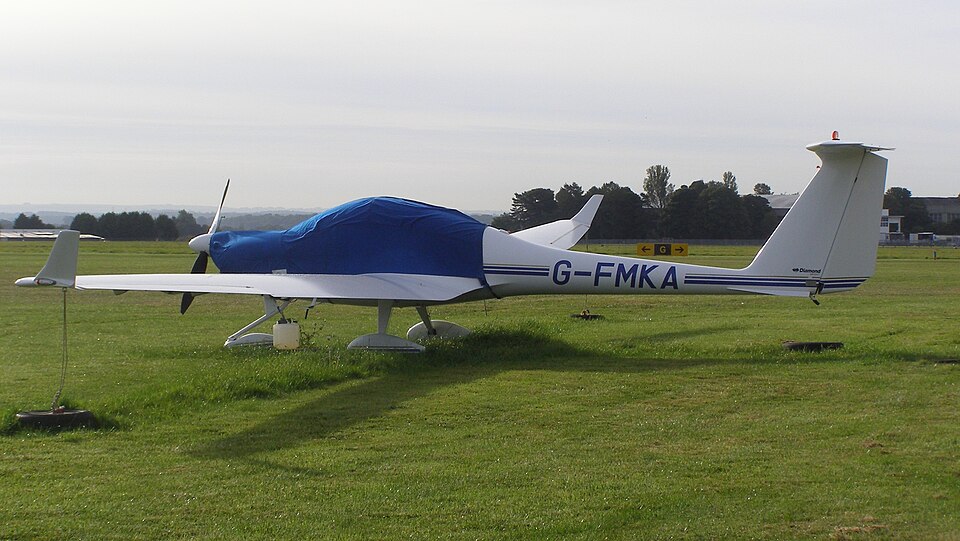
Accident Overview
On 13 July 2017 at approximately 1830 hrs, an HK36 TC Super Dimona, registration G-FMKA, crashed in a crop field near Brimslade Farm, Wiltshire. The aircraft was engaged in a training flight intended as a biennial refresher for the aircraft owner to revalidate his class ratings. Both pilots—the 57-year-old owner with 18,200 hours of flying experience and an instructor—were fatally injured. The aircraft was destroyed by impact and subsequent fire.
Flight History
The owner flew the aircraft solo from its base at Nympsfield to Draycot, arriving around 1745 hrs. The instructor had completed three other instructional flights earlier that day and was asked to conduct this flight—his first time in a Super Dimona. Short discussions between the two pilots were observed before departure, but their content is unknown. The planned flight duration was one hour.
At Draycot, a witness observed normal control and engine run-up checks, including airbrake operation. The aircraft took off at 1810 hrs and departed south toward Marlborough. No radio calls were received from the aircraft, and none were expected.
Witness Observations
Around 1820 hrs, a witness holding a Private Pilot's Licence saw a aircraft believed to be G-FMKA over Marlborough at about 1,000 ft agl, heading south with the engine running and wings level. Shortly after, several witnesses near the accident site reported seeing the aircraft manoeuvring at a lower altitude than expected. They described hearing engine noises, with some noting an increase in engine power in the later stages. The aircraft was consistently seen in a left turn during the final moments.
The closest witnesses, about 400 metres from the crash site, reported the aircraft as low as 100 ft agl and believed it was going to land. Another witness described the aircraft as “spinning around one wing and looked very nose‑down” before trees obscured the view. None observed the actual impact.
Accident Site
The accident site lay in a gently sloping crop field surrounded by tall trees on three sides. Ground impact marks indicated the aircraft struck the ground in an extreme nose-down attitude at considerable vertical speed. The engine section was buried back to the bulkhead. A post-crash fire, intensified by the crop, consumed much of the wreckage. Emergency services continued damping down the fire approximately four hours after the accident.
Aerial photography by the AAIB’s drone revealed symmetrical curved impact marks from the wing leading edges, centred at the engine impact point. The pronounced curvature indicated significant upward wing bending at impact. The aircraft manufacturer estimated a positive acceleration approaching 9 g was required to produce such marks, and stated that such loads could not be achieved without elevator control input.
Aircraft Information
The HK36 TC Super Dimona is a touring motor glider (TMG) certificated by EASA, manufactured primarily from glass reinforced plastic. It features conventional flight controls and upper wing surface airbrakes. The two-bladed propeller can operate in constant speed mode or be feathered for gliding.
According to the flight manual, with power on and at 50% to 100% power in wings-level flight with maximum rearward centre of gravity, the aircraft may perform a “stall dive” over a wing after entering a horizontal stall if the control stick is pulled further. Recovery requires immediately relaxing elevator force; pulling further could lead to a spin.
Wreckage Examination
Examination at the site and after recovery showed extensive fire damage. The fuselage between the engine bulkhead and wing carry-through box was destroyed. Most remaining composite structure was reduced to glass fibres. Identifiable components included both wingtips, tailplane, elevator, fin, rudder, and the inboard section of the left aileron. The outboard left aileron and a portion of the elevator were missing or destroyed by fire. Control tubes and bell cranks in the wings showed no pre-impact failure. The fuselage disruption precluded effective examination of the control mechanism under the seats. Fractures in tubing exhibited compressive buckling consistent with impact loads.
Recorded Information
A 'Flymap L' GPS unit was recovered but damaged beyond data recovery. Radar did not detect the aircraft, indicating it likely flew below 1,500 ft amsl (about 1,000 ft agl) based on line-of-sight limits of nearby radar heads.
Injuries
Both crew members sustained fatal injuries. No passengers were on board.